Teenage consultants advise Alpharetta on vacant property

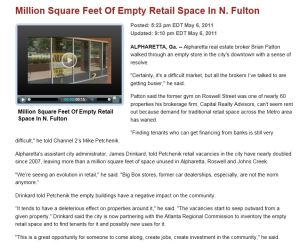
The other day Channel 2 in Atlanta had a news report about a vacant car dealership in Alpharetta and mentioned that the city was asking the Atlanta Regional Commission for help in finding a use for the property. You can read the report by clicking the picture below:

Then today I saw this article about kids that had found a use for vacant car dealerships in Alpharetta:

According to Alpharetta police, the five, whose names have not been released, broke into a vacant building in the 1400 block of Alpharetta Highway that was formerly an automobile dealership and set up a skate park.

So a few of Alpharetta’s enterprising youths have already solved the city’s dilemma: The city needs an indoor skateboard facility on the site! The market has spoken.

Feds investigating Alpharetta mosque decision

AJC has this article about the federal government’s intrusion into the local expansion of a mosque that was denied by the Alpharetta City Council.

The underlying issue is complicated and I don’t feel strongly about the outcome one way or the other. When it comes to zoning issues that don’t directly impact my wallet or family I prefer to let the people who do feel strongly about it work it out.

But I do think some people may misinterpret what is going on here. The problem is that when mosque supporters originally asked to zone the property for that use the neighbors welcomed them into their community based on promises that the mosque would not be expand into something more intrusive. Now the mosque supporters want to expand into something that will dramatically increase the size and impact. I don’t blame the neighbors for being mad about that so for me it just comes down to the fact that the mosque backers made promises to their neighbors and the city decided to make them live up to those promises.

I am not naive enough to think that the building being a mosque doesn’t matter to any of the opponents but I do remember when the Jewish Temple on Kimball Bridge Road wanted to expand dramatically  and their nearby community fought it too. Trying to make this a religious discrimination issue is an oversimplification. I also wish the federal government would spend more time trying to balance their checkbook instead of imposing their will on local zoning issues.

But regardless of the outcome I do savor this opportunity to watch some of the same people that have staunchly defended the private property rights of politically connected developers as they now staunchly defend the right to trample those rights. Schadenfreude anyone?

The new and improved Alpharetta City Center

There is an article on the Patch this morning that suggests the new city center project will be unveiled on Monday. Good. For at least a couple of years the city of Alpharetta has been assembling land downtown and it is about time the residents picking up the tab see what is being planned for their tax dollars.

While city council members have been hyping the project to me for months they have refused to provide any hard details so I have no idea whether the project will be worthwhile or not. I will reserve judgement until I have a chance to see what is proposed.

But if you are curious what may be coming I suggest you take a look at the changes the city has proposed for the downtown area in the new land use plan (that council hasn’t approved or condoned but submitted to ARC for approval anyway). The city of Alpharetta has been working on the new city center ever since the last one failed so I think it is safe to assume that they would not be proposing a new land use plan that did not conform with it.

Downtown changes

City Center

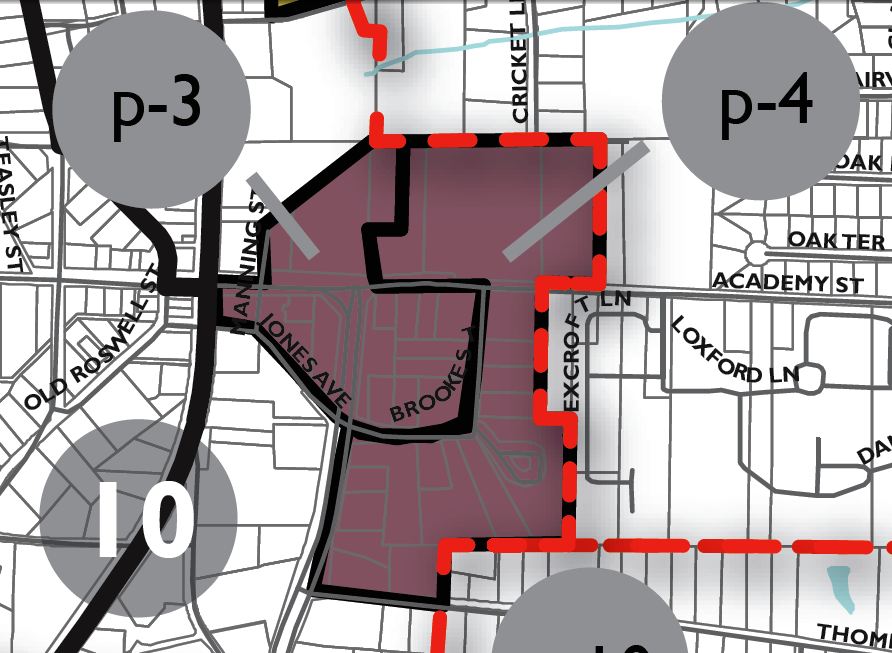
According to the proposed CLUP changes the area noted above as P-3 will be zoned as “central business district”. Since we aren’t privy to the city’s intentions yet let us assume that the area will include a new city hall as proposed before, the land that the city has already voted to donate for a new library and other such commercial uses.

Then note that the vast majority of land covered by the new city center is identified as P-4. According to the legend of the new CLUP that property will be developed as high density residential. We can’t know for sure but based on the failed city center proposal there will likely be a large condominium development surrounding an open space designated as a park.

The map above is a fact but there is always the unlikely chance that it doesn’t conform to the new plan to be unveiled soon. The rest is simply conjecture based on what the city tried to do before. The rumor mill says that the bond issue needed to pay for the new city center would cost between 25 and 30 million dollars.

I know the same people that supported the last city center project are once again lined up behind this one. And I know that there are others that didn’t like the last proposal that are already on board this time. I am glad the public may soon see what is being cooked up so we can make a decision for ourselves.

The incredible disappearing transit machine

Last Friday an agenda item about a transit presentation by Greater North Fulton Chamber of Commerce CEO, Northpoint CID Director and Georgia DOT Board member Brandon Beach magically appeared on the Alpharetta City Council docket for Monday night. I was surprised to see such an item appear out of thin air and wrote about it in this post over the weekend.

Well apparently I wasn’t the only one surprised. Several City Council members told me that they didn’t know anything about it until last Friday either.  Then yesterday, as magically as it appeared, the transit presentation disappeared and never took place. Curious stuff.

Maybe Mr. Beach saw the recent article “The Public Transport Revolution – Why does it never Arrive?” on Newgeography.com and realized that MARTA trains were a waste of time and money. You can read the whole article here but below are a few highlights.

Urban economist, Anthony Downs, writing in “Still Stuck in  Traffic?” reminds us:

“….trying to decrease traffic congestion by raising  residential densities is like trying to improve the position of a painting hung  too high on the living room wall by jacking up the ceiling instead of  moving the painting.”

******************

One of the arguments used against building more roads – and  especially against more motorways – is that as soon as they are built they  become congested again because of “induced demand.” Such “induced demand” is  surely the natural expression of suppressed demand. It seems unlikely  that motorists will mindlessly drive between different destinations for no  other reason than they can.

However, let us accept for a moment that “induced demand” is  real, and suggests that improving the road network is a fruitless exercise. Advocates  of expensive rail networks claim they will reduce congestion on the roads and  improve the lot of private vehicle users as a consequence.

But surely, if the construction of an expensive rail network  does reduce congestion on the roads then induced demand will rapidly restore  the status quo. Maybe the theory is  sound after all. It would explain why no retrofitted rail networks have  anywhere resulted in reduced congestion.

This is the time to invest in an enhanced roading network while  making incremental investments in flexible public transport. Roads can be  shared by buses, trucks, vans, cars, taxis, shuttle-buses, motor-cycles and  cyclists – unless compulsive regulators say they are for buses only. Railway  lines can be used only by trains and if we build them in the wrong place they  soon run empty. The Romans built roads and we still use them.

So maybe the incredible disappearing transit machine shows that local business leaders now realize raising sales taxes to pay for expensive, inefficient trains is a waste of time and money. And maybe the Georgia Department of Transportation will make up for decades of neglecting roads in what has been one of the fastest growing areas in the nation.

And maybe I’ll ride a flying pig to Braves games this Summer.

Hmmm…

Newgeography.com:

Cities across America have invested enormous sums into  downtown redevelopment and major projects in selected districts.  The good news: these investments have shown  some ability to move the needle in terms of attracting young professionals  downtown.  The bad news lies with the  fact that these developments have been extremely costly, and have not  transformed the overall demographic or economic climates of the cities that  tried them.  This demonstrates the limits  of the policies. Those who aren’t in the  young professional, empty nester, or creative class demographic have rightly figured out that they are no longer the target market of city leadership. No surprise then that many of them have decided to vote with their feet.

Alpharetta Neighbor: “Alpharetta sends comprehensive plan draft to ARC”

Here is the article by Rachel Kellogg at the Neighbor.

Alpharetta City Councilman curiously contorts the definition of approval:

Though council voted unanimously in favor of the resolution, Councilman Chris Owens explained that the approval allows the draft to be reviewed to move the process of adopting the plan along.

“This is not an endorsement or approval of any sort,” he said.

“It’s just a point on the time line that we must meet to stay on schedule.”

So the Alpharetta City Council unanimously voted yes to submit their draft of the new land use plan to the Atlanta Regional Commission… but they don’t approve of it?

Bill Clinton would be so proud.

Smart Growth transfers quality of life to the rich at the expense of poor?

A recent article on newgeography.com caught my eye because it criticizes the current fad of “smart growth” policies from the perspective of an avowed leftist. The article is written by Richard Morrill, a professor Emeritus at the University of Washington and his analysis leads him to believe that the liberal land use policies currently embraced by urban planners end up hurting the poor and minorities in Washington state.

I suggest you read the whole thing for context but below are some of the money quotes from Professor Morrill:

Population change in the state of Washington has relevance to the nation and to other states because it tells us something about market preferences of households versus the orientation of planners (e.g., “smart growth”).

****************

To a leftist like me, the tragedy is how smart growth transfers wealth and the vaunted “quality of life” to the rich and the professionals, at the expense of the poor and of minorities. Sadly the Democratic party seems totally blind to the fact that the fixation on new urbanism contributes to the rightward backlash. Folks do not want to be told how to live, especially, dare I assert, when those hectoring them have already cornered the nicest parts of the region for themselves. Middle and working class families are not likely to embrace policies – beloved by affluent professionals – that would deny them a chance to own their preferred kind of residence at a reasonable price.

*****************

As the late great UW economist Charlie Tiebout told a seminar 50 years ago, “People vote with their feet”  This is certainly true about residential choices. While perhaps twenty percent at most of Americans may prefer higher density living, for reasons of age, family status or ideology, the large majority does not and likely will not.

*****************

Growth management and upzoning have been unable to stem this tide, for two main reasons rarely acknowledged by planners: the preference of families with children for single family houses and greater housing affordability, at least in some areas…

Most people don’t want to be crowded into densely populated concrete jungles. “Smart growth” reduces the acreage available for the single family homes that the vast majority of Americans want. By reducing the supply of single family homes “smart growth” inflates their price which makes the dream of home ownership unattainable for millions of people. It is basic Econ 101. So either urban planners don’t care what people want or their goal to force Americans into more efficient densities whether they like it or not.

Wealthy Americans will always be able to afford single family homes. Forcing land use policies that are abhorred by the majority of people in a city ensures that those areas will only appeal to a minority of the population and the people unable to afford anything else.

That may be efficient but it sure as heck isn’t smart.

When you are kicking the competition’s butt, don’t stop kicking… part 2

In my last post I discussed an article by Pat Fox of the Atlanta Journal Constitution which highlighted Alpharetta’s tremendous success attracting lucrative technology jobs. There was also another article in the AJC about Alpharetta but unfortunately that one is not posted online so I contacted the writer, Rachel Tobin. Ms. Tobin graciously said that I could reprint the article here as long as I give the newspaper credit.

It is an excellent article so I am going to try something different today by posting the whole article with certain key phrases highlighted. After the article you can read my comments.

The big money still heads to Alpharetta
Top industries flock to hot office submarket.Besides company HQs, call and data centers also move into area.
Rachel Tobin / Staff

Thirty years after striking out to attract the executive set by building grand homes around bucolic golf courses and horse farms, Alpharetta has succeeded in its mission of also luring the companies that employ those executives. The result: Alpharetta is no longer just an enclave for well-heeled executives. It’s become a hub of call and data centers for Fortune 100s like Coca-Cola, as well as regional corporate offices for other companies with household names. Think Motorola, Philips, Comcast Cable, health care services firm McKesson Provider Technologies and information service Lexis-Nexis.

Despite the 40-minute-plus drive from Hartsfield-Jackson International Airport — and sometimes choking traffic — Alpharetta remains one of metro Atlanta’s most competitive office submarkets. It’s successfully been attracting — and keeping — some
of the nation’s hottest industries, from technology to health care. The city was anointed the country’s No. 1 “reloville” by Forbes in 2009. Rival office markets like Central Perimeter have lost big tenants to Alpharetta, which boasts office rental prices that are up to 10 to 15 percent lower.

With housing stock that goes from $85,000 starter homes to multimillion-dollar mansions, Alpharetta is not just for CEOs anymore. Alpharetta’s daily workforce now includes lower- to mid-level staffers at data and call centers as well as regional headquarters for internationally known companies.

Holder Properties has developed 20 to 30 data facilities in north Fulton, said Tim Bright, an executive vice president.
“Because so many data centers have gone there, others are going because of the critical mass of talent, intellectual expertise and vendors that service them, ” he said. “It’s the cool place to be.”

Sarah LaDart, a project manager for the North Fulton Chamber of Commerce and Progress Partners, an economic development group, said the area has “been very aware that not every job created in Alpharetta is a $200,000-a-year job. A stone’s throw from the chamber, we have homes that are $100,000.”

Adam Viente with Jones Lang LaSalle describes what he tells potential office tenants at Sanctuary  Park in Alpharetta: “We have million-dollar-plus homes and golf course communities, as well as entry-level housing. And every amenity you could imagine.”

One of those continues to be Alpharetta’s serene setting. On a recent day, traffic was stopped in Sanctuary Park as geese crossed the
road. One of the most popular features at the office park is its softball field, where 16 teams of tenants battle it out for the coveted end-of-season trophy. There’s also a foot path to Verizon Amphitheatre.

Still, “call center” is not exactly what some want the area branded for. “I hate the term because of the connotation that comes with it, ”
Viente said. What Alpharetta has are not sweat shops, where office workers in headsets are corralled into rooms handling difficult customers, then huddle at the exits for 10-minute cigarette breaks, he said. These are sophisticated call centers, he said, handling inside sales calls for companies like Coca-Cola.

Some, for example, are longtime engineers who help restaurants fix beverage machines, added Clint Howell, also with Jones Lang LaSalle, who manages Sanctuary  Park. Many are mid-career and high-paid, he said. “Coca-Cola’s isn’t a call center in the traditional sense of the word, ” Howell said.

One of Alpharetta’s strengths, said Chris Macke, a Washington-based senior real estate strategist with CoStar Group, is its ability to attract companies up Ga. 400 from the Central Perimeter, especially technology firms like Verizon, E-Trade Financial and AT&T that have built campuses in north Fulton.

Many of these businesses will fuel the economy for years, if not decades, to come, Macke said. The result is a stabilization on the north Fulton market, which was hurt when financial service and real estate firms, battered by the recession, shed staff and offices.

Estimates for north Fulton’s overall office vacancy rate vary. CoStar says it was 17 percent in the first quarter, compared to 12.7 percent at the end of 2007. Jones Lang LaSalle reported 19.6 percent for the first quarter, compared to Cushman & Wakefield’s 18.9 percent.

Only the Central Perimeter area and northwest Atlanta have more Class A office space than north Fulton, but North Fulton’s vacancy rate is 15.8 percent, which beats metro Atlanta’s Class A average by more than three points. Central Perimeter’s Class A vacancy
is 18.7 percent, while northwest Atlanta’s is 15.8 percent, according to CoStar.

To be sure, Viente said Class A suburban office buildings aren’t the same as the glittering skyscrapers from downtown to Buckhead. Most Alpharetta office buildings are four to six stories, surrounded by ample parking in manicured settings complete with lakes and waterfalls.

But the office parks and nearby lifestyle continue to be a draw.

“I’m happy where I am right now, ” said Dave Burr, who is consulting business leader for E-Trade Corporate Services, which has a campus on Windward Parkway. He started with E-Trade about two years ago and he loves the campus. “They keep remodeling it and adding more trees and scenery, ” Burr said. “It’s a really pretty office park to come to every morning.” Across the street, there are 10 restaurants, with dozens more a short drive away.

And he raves about another feature: a running group that meets after work Thursdays to take advantage of a nearby 14-mile path that winds through woods. Burr lives in Sandy Springs with his wife, a Midtown lawyer, and their three dogs. He said his commute is a breeze, though he admits his wife’s commute is not.

Clifton Camp, who owns MarketingCamp, a marketing and branding firm, often works from his five-bedroom home in north Fulton.
A Michigan transplant, Camp is on his fifth home since moving here in 2004, continually buying and selling homes after starting with a foreclosure in Country Club of the South. A major plus, he said, is the excellent school system for his three school-aged
kids. By not paying for private school, he said, “I can funnel those funds back into the household so we can have a few of the finer things in life. That is a plus.”

Still, all interviewed by The Atlanta Journal-Constitution for this story said that the lack of a rail system is north Fulton’s biggest challenge for both future growth and quality of life.

For Viente, that means a competitive disadvantage for Sanctuary Park. “Central Perimeter has four MARTA stops. We have zero. I think that is the biggest thing this submarket is facing, ” he said. He’d like to see a MARTA stop near North Point Mall.

One of the main jobs of Ann Hanlon, chief operating officer of the North Fulton Community Improvement District, is improving transportation. “The north Fulton area is pretty easy to get around within it, but it’s difficult to get to and from it from somewhere else in the region, ” she said. “It’s a challenge, especially when more and more of our leases are going to call centers, which is pulling employees from other parts of the region.” She said when gas prices skyrocketed a few years ago, she saw people walking
long distances from bus stops in hot temperatures. “It’d be 105 degrees outside and people were walking all over Alpharetta
from the bus stations, ” he said. “We said it’s just not practical.” Her organization, with the help of other groups, is studying transit options. “We’re trying to show the suburbs are ready for transit and make the business case for it and that we can’t live without it anymore, ” she said.

About our series
Metro Atlanta has been a master of reinventing itself ever since the Civil War. In the process, the region has become the undisputed capital of the South, a hub for Fortune 500 companies, with an airport that is the envy of the region. Through it all, landmarks have risen, some have fallen, others were saved and new ones were built. As Atlanta’s ambitions grew, so did unique areas with their own flavor and style, attractions and problems. This year, The Atlanta Journal-Constitution will embark on an occasional series to check on the skyline. We aim to examine the opportunities and challenges in business districts metrowide.

To send us your ideas for the series, please e-mail Rachel Tobin at rtobin@ajc.com.

The Atlanta Journal-Constitution, Main Edition
Sunday, 4/24/2011, Business, D1

The article is filled with interviews and data that show Alpharetta is kicking the Perimeter area’s butt in attracting technology jobs and corporate headquarters. Alpharetta has higher office occupancy rates and people that have relocated their businesses and families here applaud our quality of life, serene setting and outstanding public schools.

Yet somehow the article concludes that Alpharetta needs to be more like Perimeter Center because, “Central Perimeter has four MARTA stops. We have zero.”

It makes sense that the commercial property owners of the Northpoint CID covet the higher rents of the Perimeter area and it is clear they are pressuring our city council to allow more condos and apartments to accomodate MARTA trains.

But Alpharetta is not like Perimeter Center. That is the key to our success. In the words of Ms. Tobin:

“Thirty years after striking out to attract the executive set by building grand homes around bucolic golf courses and horse farms, Alpharetta has succeeded in its mission of also luring the companies that employ those executives”

Alpharetta’s strategy is working. We are kicking the Perimeter area’s butt. Why should we stop kicking to copy them?

When you are kicking the competition’s butt… don’t stop kicking.

***A special thank you to Rachel Tobin of the AJC for writing an excellent article and allowing me to use it here.***

When you are kicking the competition’s butt, don’t stop kicking

The AJC had a couple of articles about Alpharetta this weekend. One article, Alpharetta a hotbed for high-tech companies,  was about the success Alpharetta has had in attracting high tech companies to our community. You may recall that I pointed this out in my earlier post, GA 400: Atlanta’s Information Highway.

The interesting thing about the AJC article and my blogpost is that the extraordinary concentration of technology jobs in Alpharetta would seem to be counterintuitive if you believe that Alpharetta needs high density housing and MARTA trains to attract high paid technology jobs. If Alpharetta needs high density housing and mass transit to attract high paying jobs then why are we already kicking Sandy Springs’, Buckhead’s  and the City of Atlanta’s butt when it comes to those jobs?

The explanation for Alpharetta’s success comes from Bob Trotter, the North American president of ThyssenKrupp Corp:

But what distinguishes Alpharetta from other tech-wired cities, Trotter said, is its proximity to all the elements that contribute to an inviting lifestyle — good schools, good roads, access to university systems, quality housing, the Verizon Wireless Amphitheatre.

***************

“If it was just technology, we’d have located to Chicago or Dallas”

Are there companies that want to locate near MARTA stations and high density housing in Atlanta? Yes, but those companies already have plenty of options around Atlanta. Right now Alpharetta is unique and that is why we are successful in attracting high paying tech jobs. Our setting and quality of life give us a competitive advantage over those other locations.

It is too bad that local business leaders and city council members are destroying that competitive advantage.

We don’t need no stinkin’ Windward

A commenter on an earlier post cited a study used to justify the transit system’s expansion of train service into my neighborhood. The study was paid for by MARTA and conducted as part of the North Line Transit Oriented Study which was presented in 2006.

Part of the research was conducted through telephone surveys of nearby residents and the report states:

The telephone survey sample was selected to include residents near each of the 4 proposed TOD sites: Holcomb Bridge Road and GA 400, Haynes Bridge Road and GA 400, Old Milton Parkway and GA 400, and Windward Parkway and GA 400.

So let us take a look at the map showing the areas surveyed. You can click on the picture below to enlarge it.

Many of the dots above indicate where people work in addition to where they live but do you notice anything unusual in the top, right area of the survey map? I do because that is where I live. A tiny little neighborhood called Windward with more than 2,400 homes. Notice how not a single one of the surveys conducted was of a Windward resident? Odd isn’t it? Not one of the thousands of people interviewed lived or worked in the largest neighborhood in North Fulton county.

So what are the odds that a legitimate, random survey would completely avoid an entire geographic area that contained about 1/6th of a city’s population? It’s been a couple of decades since my statistics classes but I’d say the probability of that happening accidentally would have to be less than 1%. If any of you are well versed in probabilities and take issue with my WAG please feel free to correct me.

But regardless of the actual probability, the point is that a survey which is used to justify putting a MARTA train station in my neighborhood did not ask one single person out of the thousands most affected for their opinion. Alpharetta’s elected officials are making decisions based on a survey that completely ignored 1/6th of their constituents and that should be unacceptable whether or not it occurred by design or chance.