Kyle Wingfield: “One conservative’s approach to mass transit: Control costs”

The Atlanta Journal and Constitution’s Kyle Wingfield has a great column on the astronomical expense of public transit projects. Read the whole thing here.

This is a sample:

  • For a five-phase light rail line parallel to I-85, from Doraville to the Gwinnett Arena: $70 million per mile.
  • For a combination heavy- and light-rail line from the Lindbergh MARTA station to Emory University, $92 million per mile.
  • Some kind of “fixed guideway” transit — light rail or possibly bus rapid transit — from Doraville across the top end of I-285 to the Cobb Galleria area, at $67 million per mile


Transit advocate boots taxpayer advocate from train pep rally

I saw this article from the Marietta Daily Journal referenced by Lee over at rootsinalpharetta.com and want to pass it along here as well. The article is about a pep rally for business leaders that want to leverage higher taxes on the public into higher profits for themselves. Nothing surprising there but the section below is just too perfect to let slide:

Lance Lamberton, president of the Cobb County Taxpayers Association, attended Wednesday and tried to distribute copies of a letter to the editor he wrote that was published in the Journal last month. But he was asked to leave by an unidentified person.

So transit advocates and business leaders that want higher taxes to pay for their pet projects don’t appreciate taxpayers criticizing their expensive and grandiose plans? I sure am glad that would never happen around here…

Money grubbing bureaucrats find they didn’t need to extend GA 400 tolls after all

According to the article Ga. 400/I-85 to be rebuilt, but was new toll needed?  in the AJC:

… for Ga. 400 toll payers who once expected the toll to expire this year, the congestion relief will be bittersweet.  As they now continue paying the toll for another decade to fund the interchange project and others, there is a new kicker. The bid the state accepted Friday for the project is far lower than the state estimated it would be when it made the case that the toll had to be extended.

So low, it raises the question of whether the toll extension was necessary in the first place.

*************

The Atlanta Journal-Constitution noted at the time that the toll authority expected to have $42.5 million  in excess toll reserves at the conclusion of the original toll, meaning that the state did not need to extend the  toll to pay for the  I-85/Ga. 400 interchange. However, Perdue, who chaired the authority as governor, replied that not just those projects, but others  along the corridor needed to be done, too.

If bids on all 11 of those Ga. 400 projects — estimated by SRTA last fall at a total of $67 million — come in at the same low rate under the estimates, the state wouldn’t need the new toll to build any of them.

************

Gena Evans, director of the toll authority, told a legislative panel earlier this year that eliminating the toll could impair the state’s bond rating as well as confidence with investors in public-private toll projects.

Ms. Evans neglected to mention that removing the toll would also impair her ability to collect a six figure salary as the state’s head toll collector if the tolls stopped as promised.

As a wise man once said,”Once you vote to give the government your money they will do with it what they damn well please.” Remember this any time  government asks you for permission to take more of your money.

Transportation follies continue

The third act of Georgia’s transportation tax follies began this week as the planning director of the Department of Transportation, Todd Long, announced his list of projects which could be funded with the tax increase. If passed by voters, Metro Atlanta taxpayers will be expected to pay an additional 8 Billion Dollars over the next ten years. With this week’s release of potential projects the state has winnowed the list down to a mere $23 Billlion. But since 23 Billion is nearly 300% of what can be expected from taxpayers the rest of the cuts will have to come from that master of efficiency known as a government committee.

The AJC has an article about this most recent revision of the transportation project list and you can read the whole thing here. Below are a few of the highlights:

A group of 21 local elected officials must take those $22.9 billion worth of projects and jettison about $15 billion of them, because the penny tax would raise only about $8 billion over its 10 years

*************

For  the moment, this is it: $14 billion worth of transit projects, $8.6  billion worth of road projects, $205 million in sidewalk and bicycle  projects, and $28 million for aviation.

Long emphasized that the  $14 billion price tag for all the transit was just a reflection of the  high cost of new transit capital projects, not his opinion on how much  the region should spend on such projects.

*************

Bodker (Johns Creek mayor) is ambivalent about the idea of Ga. 400 transit. While he favors transit, he said it has to be the right project, a sustainable one, so he’d like to see it studied first.  MARTA staff did not put the project on the agency’s list because of the difficulty and expense of crossing the Chattahoochee River to get to the next jobs center, staff members told their board.

But other officials in north Fulton favored putting the $839 million line on the list, Long said.

So the director of planning added an $839 million MARTA train extension to Roswell because “other officials in North Fulton” favored it. I can’t imagine who those other officials  might be.

The MARTA train is projected to cost 10% of all the money collected from every taxpayer in the metro Atlanta area over ten years and wasn’t even requested by the people of Roswell. That is the kind of decision making which will doom this entire transportation tax boondoggle.

I am starting to believe that the tax increase is doomed. And while I never thought the tax increase was a good idea, it is sad that the state will have wasted two years by the time voters make it official.

Douglas Road in Alpharetta is closing

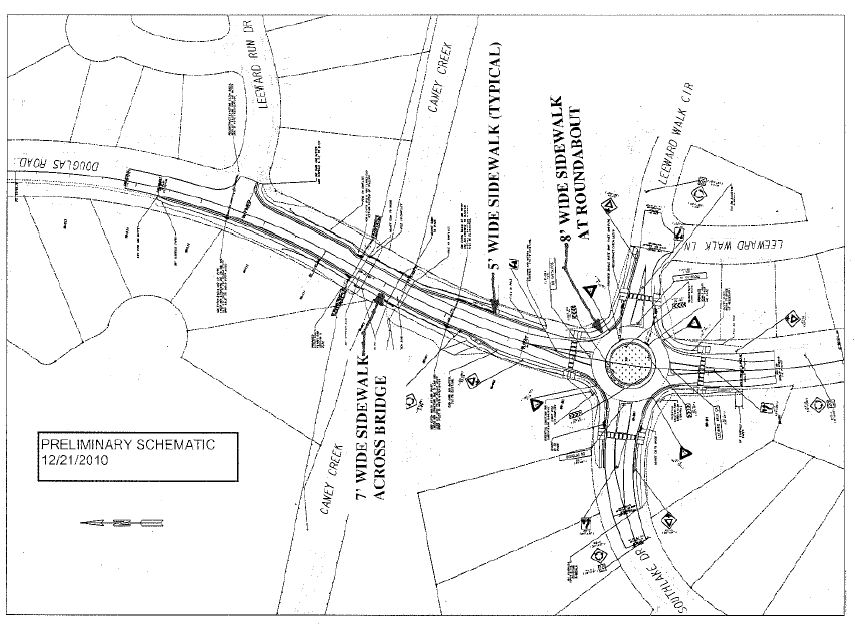
The next few months are going to be a traffic nightmare in my neck of the woods. The city of Alpharetta is going to be installing a new bridge and a traffic circle at one of the most dangerous intersections in Northeast Alpharetta and the resulting construction is going to cut off a vital roadway for thousands of area residents.

Prepare to take a circuitous detour if you usually drive the length of Douglas Road and I urge people to allow extra time for any travel through the Douglas Road area. Below is a diagram of the work to be done:

I am curious to see how the traffic circle works in this area because I have never seen one in a location quite like this. I’m also skeptical of how well it will work but the intersection is a dangerous one and the city really didn’t have any other valid options so I hope to be pleasantly surprised once the work is completed. If nothing else the traffic circle may encourage some of the cut through traffic in the area to avoid Douglas Road altogether.

Facts are stubborn things

Years ago I noticed that the people who champion high density development as being a solution to traffic, job creation or pollution invariably have no empirical evidence to support their claims. New urbanism is not a science it is a religion because it relies on blind faith from those that believe in it. I mention this because a new post over on newgeography.com discusses this extraordinary phenomenom.

The piece is titled Planning Decisions Must be Based on Facts and you should read the whole thing here.  Below is the part I found most fascinating:

We are told that high-density imposed on areas originally designed  for low density is good for the environment; that it provides greater housing  choice, that it reduces housing cost, that it encourages people on to public  transport; that it leads to a reduction in motor vehicle use and that it saves  on infrastructure costs for government. Not only do none of these claims stand  up to scrutiny in any significant way, the contrary mostly prevails.

Movements advocating  high-density show characteristics of an ideology, their members’ enthusiasm  resulting in a less than objective approach. The desire by these individuals to  be socially and environmentally responsible and to identify with a group  marketing these imagined benefits is understandable. Some may even benefit  professionally. However the result is policies for which no objective favorable  justification can be provided and which are not wanted by the greater community  who have to live with the consequences.

A while back a transit supporter became beligerent when I suggested MARTA trains were a horribly expensive and inefficient way of  trying to solve Atlanta’s transportation issues. In trying to prove me wrong the transit believer cited a 100 or so page paper to support his claim that MARTA would help create jobs.

Much to his dismay I  actually read the report and found this line clearly written among the pages otherwise filled with transit supporting propaganda: “Certainly the study results do not indicate a causal relationship between increased access to public transit and increased labor participation.”

So the report that was being used to justify MARTA expansion clearly stated that there was no evidence it would actually help create jobs. Did the transit supporter realize his mistake and change his opinion? Of course not. He got even angrier at me for pointing out the truth.

Facts are stubborn things while faith is the belief in something despite a lack of evidence. I find that when people start using terms like “smart growth” and “sustainability” it is because they generally have no facts to support their faith.

The fallacy of mass transit as a transportation solution

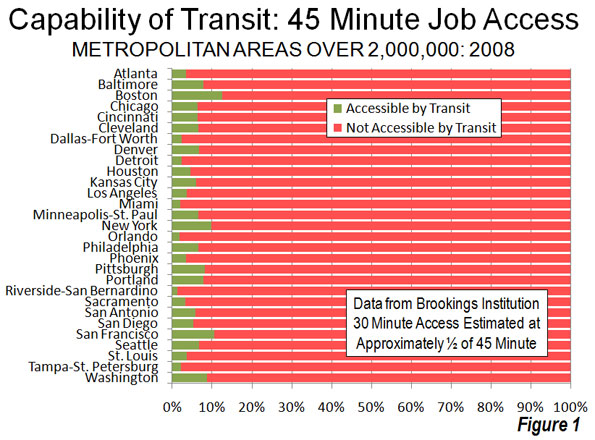
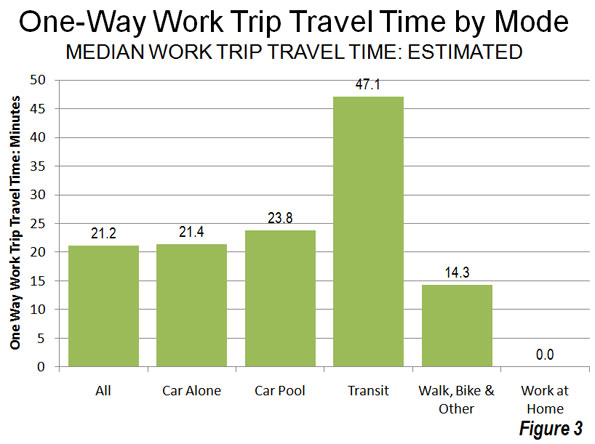
There is a new article on newgeography.com that once again illustrates how misguided mass transit supporters are when they offer public transportation as a viable solution to Atlanta’s traffic problem. The article is entitled “Transit: The 4 percent solution” and you can read the whole thing here. Below are a few highlights and you can click on the graphs to see larger versions:

A new Brookings  Institution report provides an unprecedented glimpse into the lack of potential  for transit to make a more meaningful contribution to mobility in the nation’s  metropolitan areas.

*************

… according to Brookings, only seven percent of jobs in the nation’s largest metropolitan areas can be reached  by residents in 45 minutes during the morning peak period (when transit service  is the most intense). Among the 29 metropolitan areas with more than 2,000,000  population, the 45 minute job access average was 5.6 percent, ranging from 12.6  percent in Boston to 1.3 percent in Riverside-San Bernardino. The New York metropolitan area’s 45 minute job access figure was 9.8 percent (Figure 1).

****************

Transit’s overall median work trip travel time was  more than double that of driving alone (Figure 3).

**************

More money cannot significantly  increase transit access to jobs. Since 1980, transit spending (inflation adjusted)  has risen five times as fast as transit ridership. A modest goal of doubling 30  minute job access to between 6 and 8 percent would require much more than  double the $50 billion being spent on transit today.

Moreover, there is no  point to pretending that traffic will get so bad that people will abandon their  cars for transit (they haven’t anywhere) or that high gas prices will force  people to switch to transit. No one switches to transit for trips to places transit  doesn’t go or where it takes too long.

There is a great deal of information I have not included here so please read the entire article to understand the context before drawing any conclusions for yourself. But the fact remains that there are volumes of evidence showing transit is not a practical solution to Atlanta’s traffic problems yet many of our area’s transportation decision makers choose to ignore those facts.

Even with a transit system subsidized by billions of dollars each year in a metropolitan area as dense as New York City there are fewer than 10% of the residents that can get to work on transit in less than 45 minutes. That isn’t a solution it is a problem.

AJC: “Cherokee could be tough sell on transit vote”

The latest edition in the AJC’s ongoing series about the upcoming vote to increase Georgia’s sales tax explores the reaction in Cherokee County. I will post some highlights below but you should read the whole thing here.

But it’s an open question whether using part of the transportation tax for mass transit somewhere else in the region might be a lightning rod for residents in the distant suburbs, including Cherokee.

*******************

A public-private project to add toll lanes to I-75/I-575 in Cobb and Cherokee counties could wind up on the final list of projects the tax would fund.

*******************

“People in our group will actively oppose it,” he said. “We think the government needs to back off and let this economy recover a little bit first.”

The snippets above illustrate three of the biggest challenges facing the state of Georgia and the various Chambers of Commerce which are pushing the tax increase.

First, the majority of urban dwellers won’t vote for higher taxes to pay for roads while the majority of suburban dwellers won’t vote for higher taxes to pay for mass transit they won’t use. Watching tax increase advocates attempt to convince both groups they will get what they want should be entertaining.

Second, will taxpayers vote for higher taxes to build toll roads that will take even more money out of their pockets? I can’t speak for Cherokee County residents but based on our experience with the false promises about GA 400 tolls in Fulton County I personally wouldn’t make that mistake again.

Third, the U.S. economy is in the tank so is it really the time to take more money from people suffering from 10% unemployment, sinking property values and rampant inflation for food and gas? I think politicians are underestimating how sick taxpayers are of being asked to did deeper and deeper for more taxes regardless of how good the cause.

There are a lot of politicians, consultants, lobbyists and developers dedicated to passing this tax increase and don’t doubt for a minute that they will do whatever it takes to get it passed. They will also promise gullible voters anything to get their vote so don’t forget my maxim when it comes to tax increases,”Once you vote to give the government your money they will do with it what they damn well please.”

The public transportation money pit in perspective

*Editors note:Please read the update posted below the original article*

The AJC has started a series of articles designed to give a comprehensive assessment of Georgia’s transportation situation as the state decides whether to raise taxes in the hope of solving the state’s transportation problems. The first article in the series is titled Atlanta at heart of area’s transit issues and you can read the whole thing here.

As the AJC continues their series I will examine their coverage from my own perspective and today I want to focus on the paragraph below because it illustrates beautifully how the absurd inefficiency of public transportation and the resulting cost to taxpayers is overlooked by proponents as well as those responsible for covering transportation issues.

One thing Atlanta wants to do, if the project makes the final list, is pump $861 million into 
MARTA to bring the “system into a state of good repair.” Tom Weyandt, Atlanta’s senior policy adviser for transportation, said MARTA currently has a $1.6 billion backlog on repair projects.

The current MARTA sales tax costs Dekalb and Fulton County taxpayers more than 300 Million Dollars a year but the system still has 1.6 Billion Dollars  worth of maintenance projects that they can’t afford to pay for? In these days of trillion dollar federal deficits people have become completely desensitized to astronomical numbers but let us take a moment to put 1.6 Billion Dollars in perspective. This is what 1.6 Billion Dollars looks like: $1,600,000,000.00.

According to the 2010 census there are now 420,000 people living in the city of Atlanta so that 1.6 Billion Dollars would be $3,809,524 for every person that lives in Atlanta. So after decades of collecting tens of billions of dollars in sales taxes, MARTA needs almost 4 Million Dollars from each man, woman and child in the city of Atlanta just to stay running! Since the average person in Atlanta makes about $50,000 a year, each resident would have to work 76 years just to pay for the repairs that MARTA already needs but it wouldn’t even begin to expand capacity, improve service or reduce congestion in any way.

The numbers being tossed around by public transportation advocates aren’t just numbers, they are money that has to be collected from people that are suffering double digit unemployment along with plummeting property values and skyrocketing prices for food and gas. Politicians and bureaucrats may treat numbers with nine zeros in them like play money but taxpayers are the ones that have to pay the bill so we need to keep this money pit in perspective.

***************************

Update 5/23/2011 7:30 p.m.

As some of you may have noticed my math on the post above was off by almost a trillion dollars and the result was a post which exaggerated the projected per capita cost to Atlanta residents a thousand-fold. Oops! It was a silly mistake which occuured because my calculator wouldn’t function in the billions and in my haste I incorrectly adjusted the numbers twice. I’d like to thank Michael Hadden for pointing out my error.

I do find it ironic that while trying to show how difficult it is to put transportation spending in perspective I actually ended up proving the point by illustrating how easily an error of 1000 percent could go unnoticed. I apologize for my carelessness and will immediately refund each of my readers a prorated share of their subscription fee. 😉
Atlanta Regional Commission disproportionately represents seniors

Today’s Atlanta Journal has an article that reminds me of something most people don’t realize: the Atlanta Regional Commission disproportionately represents seniors in the metro Atlanta community.

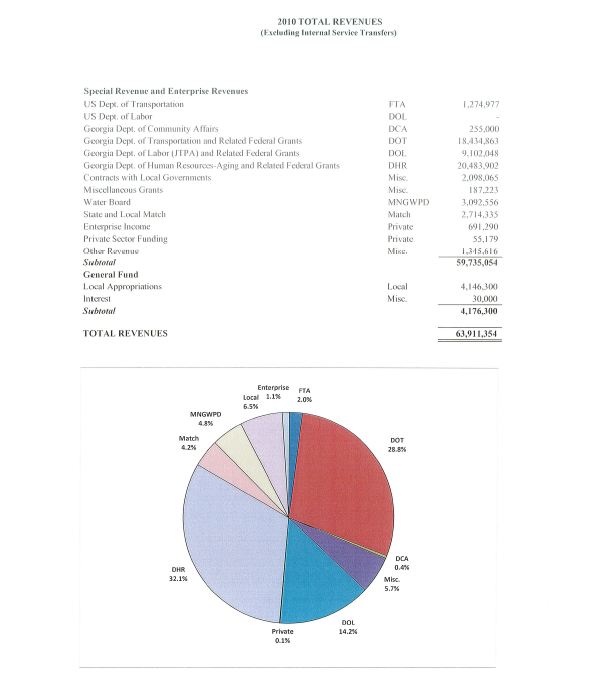
The article is Metro Atlanta getting older quickly and it is about the aging of the suburban population in Atlanta. It is a good article and I recommend you read the whole thing. As you do, also keep in mind that control of local issues like zoning and transportation are being systematically regionalized to an organization primarily responsible for providing services to the elderly, the Atlanta Regional Commission. Below is a graph of the ARC’s revenue sources and you can see that about one third of their money, more than 20 million dollars, comes from federal grants to serve Atlanta’s aging population.

ARC Revenue

The reason I point this out is that the AJC article makes it seem as though Atlanta is overwhelmed by an elderly population that it estimates to be 472,000 when in fact that is less than 10% of the metro area’s total population. Our aging population is certainly an important part of Atlanta’s community and future but it is still a relatively small percentage of our overall population.

And yet ARC, the organization which is increasingly responsible for the economic future of our entire state, is primarily an organization responsible for services catering to less than 1/10th of our population. Regardless of how you feel about government involvement in these kind of social programs it seems obvious that such a distortion is not in the best interest of our region.