We don’t need no stinkin’ Windward

A commenter on an earlier post cited a study used to justify the transit system’s expansion of train service into my neighborhood. The study was paid for by MARTA and conducted as part of the North Line Transit Oriented Study which was presented in 2006.

Part of the research was conducted through telephone surveys of nearby residents and the report states:

The telephone survey sample was selected to include residents near each of the 4 proposed TOD sites: Holcomb Bridge Road and GA 400, Haynes Bridge Road and GA 400, Old Milton Parkway and GA 400, and Windward Parkway and GA 400.

So let us take a look at the map showing the areas surveyed. You can click on the picture below to enlarge it.

Many of the dots above indicate where people work in addition to where they live but do you notice anything unusual in the top, right area of the survey map? I do because that is where I live. A tiny little neighborhood called Windward with more than 2,400 homes. Notice how not a single one of the surveys conducted was of a Windward resident? Odd isn’t it? Not one of the thousands of people interviewed lived or worked in the largest neighborhood in North Fulton county.

So what are the odds that a legitimate, random survey would completely avoid an entire geographic area that contained about 1/6th of a city’s population? It’s been a couple of decades since my statistics classes but I’d say the probability of that happening accidentally would have to be less than 1%. If any of you are well versed in probabilities and take issue with my WAG please feel free to correct me.

But regardless of the actual probability, the point is that a survey which is used to justify putting a MARTA train station in my neighborhood did not ask one single person out of the thousands most affected for their opinion. Alpharetta’s elected officials are making decisions based on a survey that completely ignored 1/6th of their constituents and that should be unacceptable whether or not it occurred by design or chance.
Johns Creek Mayor and Councilmen want MARTA trains… in Alpharetta

There is a very interesting article in the Johns Creek Herald. Apparently on April 11 the Johns Creek City Council discussed the issue of how little money MARTA spends in North Fulton County. They also talked about the fact that if Johns Creek residents will be expected to pay an additional transportation tax then MARTA should provide their residents nearby access to trains.

The catch is that they don’t want the MARTA trains to come into the city of Johns Creek. They just want the trains to be extended into my neighborhood of Windward in Alpharetta.

As Mayor Bodker says:

Bodker said the North Fulton cities need to look at their land-use policies to see whether they even want transit, and if they do, how they would support it. He said Johns Creek does not lend itself to trains, however, buses could connect the city to train lines extending northward via the 400 Corridor or Gwinnett County.

“These are all long-term plans that won’t happen overnight,” he said.

However, plans need to be made and land-use policies changed in the meantime. He said even those who do not use transit benefit from it, because taking cars off the road makes it easier for those who continue driving. He also said continued development is unsustainable if people continue relying on cars.

So the man who didn’t honor his word when it came to charging Alpharetta residents higher recreation fees would like us to change the complexion of our city for the good of his constituents? Right. We’ll get right on that.

And Mayor Bodker wasn’t the only one suggesting Alpharetta should change for the sake of its North Fulton neighbors.  Johns Creek City Councilman Randall Johnson said:

…something he would like to see happen is for the train line to extend all the way to Windward Parkway.

“I think you would see more people from North Fulton utilize it,” he said.

This doesn’t surprise me. I have watched as politicians and developers from Johns Creek lobbied for the urbanization of Alpharetta. And I have watched as Alpharetta City Council has acquiesced every time.

I can see how Johns Creek, Milton, Forsyth County, Cherokee County and every other person outside of Alpharetta might enjoy the convenience of having trains in someone else’s backyard. It is much less obvious how the destruction of our quality of life benefits me and my family. I will have more on this subject… a lot more… but for now I am so furious I can’t see straight.

You can read the whole article here.

I hope you all enjoy a wonderful Good Friday and Easter weekend.

Alpharetta City Council’s Wish List for a Tax Increase

Tonight the Alpharetta City Council is slated to vote on the list of projects to include on the transportation tax referendum next year. Proponents hope that a list of possible projects will entice voters into voting for higher taxes on themselves. You can see the list of projects on the city website here.

I also suggest you read this article about the transportation tax issue in today’s Atlanta Journal Constitution. The AJC article doesn’t do a very good job of summarizing the list being presented to Alpharetta City Council tonight but it does give a valuable overview of the process. Below are a few random thoughts on the transportation tax proposal:

1. I don’t trust the state of Georgia to live up to their end of the bargain. After the DOT and State Roadway and Toll Authority arbitrarily extended the GA 400 tolls I came up with a phrase to express my thoughts on the matter: “Once you vote to give the government your money they will do with it what they damn well please.”

2. Supporters of the tax increase include most of Georgia’s business and political establishment who try to portray the issue as just another penny for a great cause. It is important that taxpayers realize all those pennies add up to 8 Billion Dollars. That works out to about $3,300 the average family of four in Georgia will no longer have to buy gas, food or anything else they need.

3. Supporters of the plan point out that the tax is only authorized for ten years. Let’s be realistic, there isn’t a chance in hell that the tax will ever go away. If you doubt me look at what Cobb County did to push through the SPLOST tax extension.

4. The business and political establishment in metro Atlanta are determined to expand inefficient and expensive train service. One way they hope to achieve this goal is by rebranding MARTA as a shiny new regional transportation authority run by GRTA. Somehow they think that will make it more palatable to suburban taxpayers. This recent front page article in the Alpharetta Revue illustrates what I mean. While the article uses the transit authority in Chicago as an example it failed to also mention that census numbers show people are fleeing the city of Chicago, the state of Illinois is on the verge of bankruptcy and the Chicago Regional Transit Authority will cost taxpayers about 1.4 Billion Dollars this year.

5. Land development companies and speculators will reap billions of dollars in profits while shouldering none of the burden for the transportation improvements which increase their property values. That is why local Chambers of Commerce and Community Improvement Districts will invest millions of dollars to promote the new tax on consumers.

6. There is still no relief in the proposal for taxpayers in Fulton and Dekalb Counties who already pay a one cent transportation tax for MARTA that costs us about $350,000,000 a year. Last year North Fulton mayors threatened to withhold support for the proposed tax increase if it continued to unfairly punish their constituents but the resulting political backlash left them noticeably silent since then.

There is no doubt that the state of Georgia has neglected our road infrastructure as tax revenues boomed over the past few decades. I just think it is a horrible idea to make up for that mistake by raising taxes now that people are struggling with high unemployment, rampant inflation and declining property values. The state’s political and business community disagree.

It will be interesting to see what the people of Georgia decide when the issue reaches the ballot box.

Why would Alpharetta trade 1800 jobs for 500 condos? MARTA

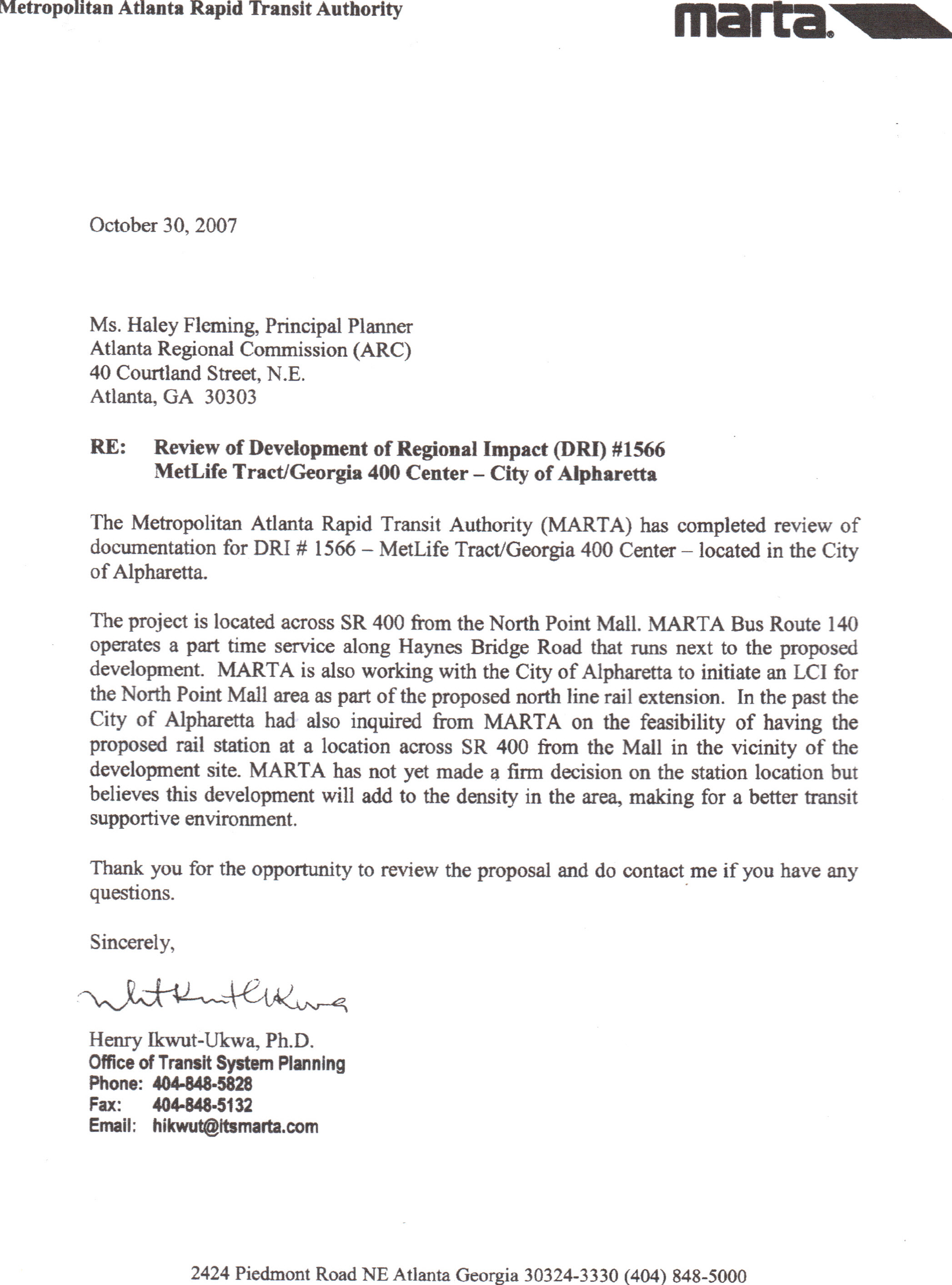
Below is a letter submitted by MetLife to justify the Peridot project proposed for Alpharetta. The new project would remove more than 1800 potential jobs from the site in return for building 500 condominiums. Why would the Alpharetta City Council do that? I will let Mr. Ikwut-Ukwa of MARTA’s planning office explain:

“MARTA is also working with the City of Alpharetta to initiate an LCI for the North Point Mall area as part of a proposed north line rail extension. In the past the City of Alpharetta had also inquired from MARTA on the feasibility of having the proposed rail station at a location across SR 400 from the Mall in the vicinity of the development site. MARTA has not yet made a firm decision on the station location but believes this development will add to the density in the area, making for a better transit supportive environment.

For at least five years the City of Alpharetta has been working with MARTA to increase the density of our city so they can justify bringing trains here. Funny, I don’t remember Alpharetta voters being asked about that. It must have happened at a charade charrette.

IF an Alpharetta mayoral or city council candidate comes knocking on your door this summer to ask for your vote don’t forget to tell them how you feel about the urbanization of Alpharetta to lure MARTA. Obviously they think it is a good idea. They just don’t want you to know.

MARTA, is it smarta for Alpharetta?

MARTA and the future of Alpharetta

In 2007 I had a conversation with an employee of Alpharetta’s Community Development Department about the future of our city. At the time the city was planning to approve a 13 story condominium building in my children’s school district and there was a lot of opposition from my neighbors. At one point in that discussion I told her,”The only reason you are trying to force this down people’s throat is so you can justify bringing MARTA up to Windward. Now people can disagree whether that is a good thing or not but it will completely change the city of Alpharetta and the people who live here should know what you are doing and have some say in it. We should be holding hearings or something.” Stunned silence was her only response.

I was reminded of that conversation when I read Hatcher Hurd’s column “Future transportation still keys off Ga. 400” in the Alpharetta Revue Thursday. In the column Mr. Hurd recalls his own epiphany about MARTA and how Alpharetta would be forced to change in order to accommodate heavy rail expansion.

 “Like a patient father, the MARTA exec told me that the Beltline would have the density of development that would make the MARTA service fiscally tenable. Windward or Roswell just don’t have the numbers – yet.”

I find it very peculiar that Mr. Hurd would liken a MARTA bureaucrat to a father figure but I do appreciate him pointing out what has been going on behind the scenes in Alpharetta for years now. It is about time that a local media outlet shed some light on the transformation that is taking place in the shadows while Alpharettans are too busy raising their families and struggling to keep their heads above water to notice. The timing of Mr. Hurd’s revelation is also fortunate that because it comes as the city is looking to choose a new mayor that will to guide us in this process.

If you doubt that this transformation is actually taking place I refer you to the MARTA North Line Transit Oriented Development Study which was developed in 2006 with the cooperation of Diana Wheeler, the director of Alpharetta’s Community Development Department. You can find the report online and I suggest you start by reading the 22 page appendix here. I’d like to point out a few of the highlights:

“This is just a concept to help the local jurisdictions create more transit-friendly development. The density has to happen before transit service can be extended. The next step is for the local jurisdictions to create the environment to support the MARTA expansion.”

“We know that higher density development leads to traffic and most officials won’t zone for higher density in order to prevent more traffic.”

“More than just carrots; developers should be incentivised to concentrate development and create higher densities.”

So as the fatherly MARTA exec said, Alpharetta may not “have the numbers-yet” but the city has been trying to change that for 5 years now. Too bad they didn’t include the citizens of Alpharetta in the conversation. Neither the mayor nor a single city councilperson has dared tell us what they are doing.

It is time for the residents of Alpharetta to finally join that conversation and there could be no better time to get their attention than during this year’s mayoral race.

Things I learned from Atlanta Progressive News

You may recall that last year the Clayton County Commission eliminated that county’s public transportation network, C-Tran. At the time you could hear the ululating of the transit advocates (the fact that people identify themselves as advocates for a mode of transportation amazes me) as they mourned the loss of a public transportation system regardless of the fiscal justification.  

So I tried to find evidence that Clayton County has suffered a negative economic consequence from a lack of public transportation. I can’t find a single shred of evidence that the county did the wrong thing. If any of you have evidence one way or another I would love to see it. I have no doubt that it was inconvenient for some people to arrange for their own transportation needs without government subsidies but I can’t find any empirical evidence which proves that eliminating C-Tran was a bad economic decision for the county.

What I did find was that after C-Tran was eliminated the Clayton County voters passed a non-binding resolution asking the county to join the MARTA system. I am sure there must have been some news coverage of the vote but I missed it and only learned of the referendum when I stumbled across an article on the Atlanta Progressive News website. The article says that the voters passed a resolution to raise the county’s sales tax by one percent and then use the money to buy into the MARTA system. Who knew? It is amazing what you can learn from the interwebs.

For example I also learned that Sonny Perdue served as governor for 10 years. I always thought the former governor served two 4 year terms but according to someone identified only as Biola, ” There’s been a complete lack of leadership for the last ten years under Perdue.” That rascally Perdue. Who knew he was neglecting transportation needs even during the last two years of the Roy Barnes administration?

But that’s not all. I also learned that Clayton County residents will be paying up to $35 million dollars in additional sales tax if the MARTA tax were passed. And that the voters have been lead to believe that $35 million dollars is enough to extend train service as well as buses into their county. That seems odd since Fulton County residents have paid billions of dollars into the MARTA system for 3 decades but the trains still don’t go into much of the county. But if transit advocates say so it must be true. Of course $35 million dollars would barely cover 10% of MARTA’s yearly operating deficit but why quibble over details.

Another thing I learned from APN is that even transit  advocates don’t expect the state’s proposed transportation tax increase to pass in 2012. The singularly named Biola reportedly also said, “he doubts the regional transportation sales tax is going to pass in 2012 in Metro Atlanta, given the difficulty of finding agreement on a project list between progressives in Atlanta and Tea Party elements in other counties.” I have to concede that Biola may have a point on that one. Those darn tea partiers just keep getting in the way every time some glorious government spending initiative comes up for an actual vote. That’s why SRTA had to pass the toll extension on GA 400 without one.

Well I think I’ve learned enough for one day but there is plenty more at AtlantaProgressiveNews.com if you want to check it out for yourself. And if you have that much time on your hands you may want to check out my previous blogposts regarding MARTA. They are listed under the MARTA category on the right side of the GA Jim home page.

Marta is on a death spiral

The title of this post is taken from a quote by Mike Bodker,  the mayor of Johns Creek, Georgia.  Mayor Bodker spoke out about the latest round of service cuts being recommended by Atlanta’s MARTA transportation system in today’s Beacon Newspaper. “We need a completely new system.,” he said. 

I expect one reason Mayor Bodker feels that way is that MARTA will no longer provide train service to North Fulton county after 7:00 pm.  One helluva “regional transportation system” we got here. Glad to know everything I buy costs 1% more just to keep up that great service!

Read the whole thing here: http://bit.ly/chFOv3

Georgia drivers as cash cows

In responding to one of my earlier posts      (https://gajim.wordpress.com/2010/02/25/marta-vs-roads-and-privately-operated-transit/  ) a commenter has pointed out that according to the Georgia Department of Transportation budget the DOT will only receive $688 million dollars from the motor fuel tax and that would only be 26% of the total DOT budget.

The commenter’s numbers were taken from this document published by the Georgia DOT: http://bit.ly/b3GBKh   I did not rely on that document for my numbers so the explanation below should clear up this understandable confusion.

The numbers used in my post came directly from the state of Georgia’s published 2010 budget numbers available online here: http://bit.ly/cIkk8c 

The state projects on page 5 of the budget that motor fuel tax revenues will be $894,250,037. The state also projects motor vehicle tax revenues of $298,968,200. These vehicle user fees combine for more than 1.2 billion dollars. It is true that the DOT only receives $688 million of the vehicle user taxes but that is because the state spends the rest elsewhere.

The Georgia DOT has a total budget of 2.6 billion dollars because they administer 1.9 billion dollars for the federal government as shown on page 2 of the GDOT document noted above. Ostensibly the federal dollars come from the money collected by the federal government every time a Georgia driver puts gas in their car and are then returned to the state.

To summarize, the state of Georgia budget document clearly shows that the state takes in 1.2 billion dollars from motor vehicle users and only spends $688 million dollars of state revenue on the entire  department of transportation. I hope this clears up any confusion.

MARTA vs. Roads and privately operated transit

This is another chapter in my continuing response to commenter Paul. In this chapter I will try to sort through the following paragraph to make some sense of the claims and arguments and then answer them to the best of my ability.

 “You say MARTA is “a government subsidized pseudo-monopoly.” Again, I refer back to the absolutely massive amounts that are spent on roads. Yes, roads are used for transport of food and goods, but so is rail. The amount spent on public transit in this country is absolutely nothing when compared to the amount spent on roads. Your statement that private sector companies would step in if there wasn’t a governement “subsidized” transit system has shown to be false over and over again. Look at cities without rail transit – where are the private lines? Why hasn’t some private developer built transit lines where there is no government competition? In fact, there is only one place in the entire country where that has happend – the “South Shore Line” in Northern Indiana/Illinois, and even that recently had to receive government money to stay afloat. Long gone are the days of private streetcars.”

Commenter: “Again, I refer back to the absolutely massive amounts that are spent on roads. Yes, roads are used for transport of food and goods, but so is rail”

Response: Surely you jest. As I pointed out before roads are the lifeblood of our entire society. To compare roads to public transportation is patently absurd and it shows that you are grasping at straws. “Massive amounts” are spent on roads because everything you need to survive is dependent on functioning roads. Roads are not an option they are a necessity. Public transportation would not exist if not for the roads that buses and cars use to reach the train station. Railroads do transport goods but they don’t deliver them to stores and unless MARTA has started a freight service it is just silly for you to bring up railroads in a discussion of public transportation. Also, roads are paid for by user taxes. Every gallon of gasoline sold in Georgia costs 50 cents more because of federal, state and local taxes.

Commenter: “Your statement that private sector companies would step in if there wasn’t a governement “subsidized” transit system has shown to be false over and over again. Look at cities without rail transit – where are the private lines?”

Response: I never said anything about private rail. I said private transit system. That private system would probably be composed of buses, cabs and other options just like it is in the vast majority of cities around the world. Doesn’t it seem odd to anyone else that there are only a handful of cities in the United States that even have commuter trains and those are the cities with the worst traffic. Perhaps the billions of dollars used to subsidize MARTA over the years could have served a better purpose and Atlanta wouldn’t face the traffic problems we see today.

In which we discuss MARTA and “equity”

Commenter: “I also have to re-stress the equity issue. In your response, you stated that you don’t want to “subsidize [my] choice” to take MARTA. What about the people who have to take MARTA? The poor, the elderly, those that can’t drive for whatever reason (legally blind, narcolepsy, DUIs, etc). Our nation has an obligation to provide them with a way to to get to the store, to work, to medical appointments. Yes, the road system works for most people, and I am happy that our taxes pay for roads. But it doesn’t work for everybody, and that is why public transit is needed.
Here’s an article from the American Planning Association showing how public transit, specifically MARTA, is needed to promote equity and availability of jobs, and has economic benefits because of this: http://www.nvc.vt.edu/uap/docs/TSpubs/sanchez_connectionpublictransitemployment.pdf ”

Response: So now your defense of MARTA is “equity”? What do you mean by equity? The dictionary defines equity as “the quality of being fair or impartial”.  How is MARTA fair?

You are apparently a healthy, gainfully employed person that makes the choice to take MARTA because subsidies from taxpayers like myself make it artificially cost efficient for you. According to MARTA you only pay 27% of the cost of your commute. Based on a $2.00 fare that means the actual cost of your trip would be $7.41 each way.  If the goal is “equity” then MARTA should charge people that aren’t disabled or disadvantaged the full $7.41 and use the money to provide better service free of charge to people that are less fortunate. We can agree or disagree whether that is a good idea but I don’t see how anyone could say it is less equitable.

You also claim that a report justifies “how public transit, specifically MARTA, is needed to promote equity and availability of jobs, and has economic benefits because of this”. I have thoroughly reviewed the report you identify and there is absolutely no evidence to support your claim in there. In fact the report clearly states on page 3:”Despite the lack of evidence, public transit system enhancements continue to be recommended to help solve central city unemployment problems” (emphasis mine). The report you refer to also says,”Certainly the study results do not indicate a causal relationship between increased access to public transit and increased labor participation.”

As I have stated before, governments and their dependent agencies are inefficient delivery systems. Even if the goal of MARTA were to promote equity and create jobs it is not an effective way of doing so.