Crisis caused by income equality or government intervention?

There is a thought provoking interview with Raghuram Rajan in the December issue of Money magazine. Mr. Rajan is one of the few economists that warned our current financial crisis was coming and the article is primarily about Mr. Rajan’s theory that the current crisis is caused by income inequality:

“In the 1980s we saw a widening of income inequality. Typically the political reaction to that is to redistribute wealth. But in the ’80s and ’90s there was a sense that we’d had too much redistribution, too much welfare. So you had to find something else, and housing fit the bill for both political parties.

The Democrats thought it was wonderful to support home ownership for the poor, their natural constituents. The Republicans figured property owners would eventually vote Republican.”

Mr. Rajan then goes on to explain how the political issue of income inequality led the United States federal government to create the current crisis with their attempts to cure income inequality. I see a great deal of truth in what Mr. Rajan says but I would like to point out one crucial difference in how I view the problem.

It wasn’t income inequality that caused the current economic crisis. The direct cause of the crisis was the political response to income inequality. The difference is subtle but completely changes the diagnosis of the problem and if we misdiagnose the problem it is impossible to come up with the correct solution.

If income inequality is to blame for our current economic crisis then the federal government could prevent future crises by eliminating income inequality. In that case the the solution would be for the federal government to continue various forms of political intervention in the hope of solving income inequality. Of course Marxism and Socialism are two examples of such attempts and their results have been devastating.

On the other hand, if the current economic crisis was actually caused by clumsy political responses to income inequality we need to look for a different kind of solution. Maybe we could start by having politicans recite the Law of Unintended consequences: “An intervention in a complex system always creates unanticipated and often undesirable outcomes”. Then we could change the oath of office to “First, do no harm”. 

The interview with Mr. Rajan can be found online at CNNMoney.com
Georgia’s GDP: “Obviously all is not well down there”

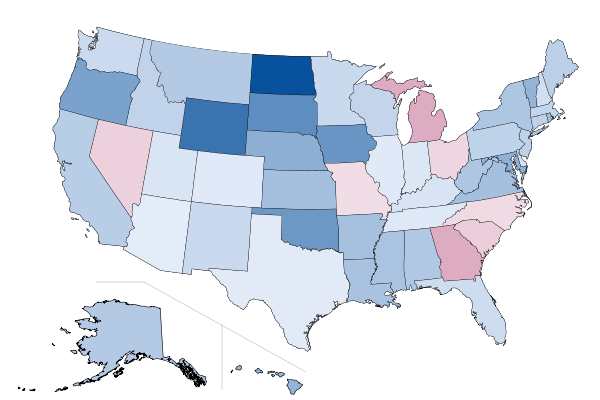
According to Newgeography.com the real per capita Gross Domestic Product of Georgia has actually declined from the years 2000-2009. Below is the map showing that the states with the largest decline in per capita GDP are Michigan and Georgia.

To quote the author, Aaron Renn, “Some of the fast growing Sun Belt states added people at a faster rate than they grew economic output. Georgia in particular is worth noting, because even metro Atlanta has been showing declining real per capita GDP. In fact, Georgia actually declined by more than Michigan did on this metric, so obviously all is not well down there.”

I was really shocked to see this but it does remind me of a map I saw a while back that showed the migration of people in and out of Georgia along with their incomes. The first thing I noted about that map was that Georgia had a positive net migration but the people moving in had much lower incomes than the people moving out.

Looking on the bright side, the good news is that more people are moving to Georgia than leaving. The bad news is that the people moving in have lower incomes.

Read the whole thing here.

If you don’t read Kyle Wingfield, you should

I have mentioned the recent editorial changes at the Atlanta Journal before and the addition of Kyle Wingfield is one of the changes that has been the most encouraging.

Back in 2009 the AJC made a big deal out of their search for a conservative columnist and the fact that it was a big deal tells you the state of the paper back then. At the time I was highly skeptical of the iniative. Based on the AJC’s recent history I expected them to end up with some blue-blood, country club Republican like Peggy Noonan that professes conservatism but has no problem supporting Barack Obama as a candidate for President. At the time I was actually rooting for Will Collier to get the job. While I still think Will would have done a terrific job I was completely wrong about the columnist that eventually won the position, Kyle Wingfield.

Kyle has turned out to be an actual conservative that looks at the issues of the day through the lens of conservative principles and it is refreshing to read him in the Atlanta Journal. I may not always agree with Kyle but he does a great job of laying out his views and I don’t ever remember him taking a position that wasn’t consistent with conservative principles.

If you are conservative and are not reading Kyle Wingfield’s work on a regular basis, you should be. That is why I am adding him to the GA Jim blogroll.

Discussion of Mixed Use Developments

One of the local blogs I frequently read is Bob Strader’s liveinalpharetta.com. Bob is also a real estate agent in this area and his blog is primarily a real estate blog. In a recent post Bob extolled the virtues of mixed use developments in North Fulton County.

The current mixed use fad happens to be one of the topics that really gets my attention so I posted a rather long comment on his blog. But I didn’t want to wear out my welcome and still have more to say so I brought the conversation back here to GA Jim.

You can read Bob’s post at the link above and below is the comment I left on his website:

“Couldn’t disagree with you more on this one Bob. Smart growth is a charade being pushed by developers because it quadruples the density of their speculative parcels thereby quadrupling their profits.

Mixed use with townhomes? That was the good old days. A few years ago Penn Hodge got a 13 story condo tower zoned on Windward Parkway. What’s an extra 12,000 car trips on one of the most congested intersections in town?

And keep in mind that if 24% of people want to live in mixed use developments that means 76% don’t. Vickery Creek and Prospect Park were supposed to be the wave of the future but they were both in trouble long before the economic collapse.

Alpharetta has been the jewel of North Fulton because it is perfect for young families raising children. You say that the demand for our schools will always be there but you overlook the impact of high density development on those schools. If you don’t believe me check the test scores for any elementary school with high density mixed use in the district.

You are right that in the future there will be mixed use developments for the 24% of people that want them. Young, single people and empty nesters will support mixed use in areas like Atlanta, Sandy Springs or Vinings that have already run off the young families.

But high density mixed use won’t succeed in North Fulton until the developers have driven out the families that live here now.”

To give you a little background, my neighborhood was faced with a mixed use zoning in our children’s school district a few years ago. In the course of that zoning battle I learned a lot.  

When I talked to politicians, developers and their circle of defenders I would ask a direct question like,”How can adding 12,000 car trips to a horribly congested intersection improve traffic?” The response was usually some silly talking point like “Mixed use developments reduce traffic” to which I would ask, “How?” and repeat the original question. At that point the other party would usually hem and haw and act as though I were an idiot for not understanding the conventional wisdom of the development community. But I’m no fan of “conventional wisdom” because I find it is rarely conventional or wise. In the end it was clear that nobody could satisfactorily answer the most basic questions.

Another thing I learned is that developers and land speculators spend a fortune promoting the concept of “livable” and “sustainable communities” in Atlanta. There are entire groups like the Livable Communities Coalition devoted to promoting the livable concept and governmental entities like the Atlanta Regional Commission accept their  sustainability as gospel. The thing that struck me as most odd was that sustainable always meant increasing the density of undeveloped land. Not once has the conventional wisdom been that a developer should build four acre parcels with a density so low that traffic would be nonexistent. Wonder why that is?

Some people may think my position is anti-mixed use development but that is not the case. I was glad to see the Vickery development in Forsyth County because it is mixed use with a very low density much like my neighborhood of Windward. And I had no problem with the Milton Park development on Northpoint Parkway. Milton Park is higher density but it is in an area that is  primarily retail.

What I oppose is the simplistic conventional wisdom that “sustainable” mixed use is some kind of panacea. If people wanted these “sustainable” communities so bad the market would demand them organically and developers wouldn’t have to create front groups to advocate for them.  I also don’t believe that high density mixed use is appropriate for suburban areas like Windward and I have yet to find a single piece of evidence that they can succeed in that environment.

Kudos to the City of Alpharetta for reducing fees as an incentive for new businesses!

I am quick to criticize government when they get it wrong so let me be one of the first to congratulate the City of Alpharetta for getting this one right. I dream of the day when the kudos outweigh the criticisms.

Read the whole thing by Rachel Kellogg in the Alpharetta Neighbor.

Blogging

Sorry for the lack of posts lately.

Technical issues have made it more difficult to post quick updates and the holidays have reduced the amount of time I have available for writing articles. If you follow me on Twitter, @jimgilvin, you can see some of the interesting items I find. The 140 character limit of Twitter relieves me of my inclination to spend a great deal of time expounding on the subjects. 

Here are some items you may want to check out:

Argument for reducing/eliminating Georgia’s income tax

Argument for not reducing/eliminating Georgia’s income tax

Tax comparison of North Fulton County and Forsyth County

I have to go write articles for my neighborhood newsletter now so I hope that will keep you busy for a while.

 If you are not satisfied that you are getting your money’s worth please send your complaints to : someonewhocares@idontgetpaidforthis.com