North Fulton mayors vote to trade MARTA funds for roads

This morning I noticed an article on NorthFulton.com which reports the mayors of North Fulton county have voted to sacrifice extending MARTA into their communities in exchange for more road money:

The North Fulton Municipal Association decided to try to trade $37 million in MARTA engineering funds for the restoration of road projects to be funded by the 2012 transportation-improvement sales tax.

********************

He said Fulton is a net donor to the tax while Cobb County and DeKalb County get a 120 percent return on their investment.

Bodker then criticized the Beltline streetcar project in Atlanta. He said it is an Atlanta project, not a regional one, but it is slated to receive $600 million in funds intended for regional transportation development. He said Atlanta is getting more than its fair share of the revenues and this money is being taken from North Fulton’s hide.

“If Atlanta wants to fund it, they have 15 percent off the top of this thing,” he said.

He said Atlanta would be paying for the project using other people’s money.

*******************

Sandy Springs Mayor Eva Galambos suggested heavy rail would never come to North Fulton, so the $37 million was money wasted.

*******************

The representatives of Alpharetta, Milton and Johns Creek voted in favor; Wood, representing Roswell, voted against it. No representative from Mountain Park was present.

While the shift of $37 million of a $8 Billion dollar tax is a small gesture it does show that the mayors of North Fulton are finally yielding to the political realities in their communities. The strange thing is that just one week earlier the same newspaper published a story from the same reporter which lead readers to believe the mayors unanimously suppported the MARTA funds: 

Bodker said all the mayors support transit, but are concerned there is no regional transit system that all participating governments support. As far as the projects are concerned, the mayors support extending MARTA to Holcomb Bridge Road and eventually Windward Parkway. At the very least, the tax should pay for the necessary engineering, which would cost $37 million. The mayors also unanimously supported completing the proposed Clifton Corridor that would connect MARTA to Emory University, Atlanta’s largest employer, and extending MARTA up I-75 to at least Cumberland Mall.

A complete reversal of the North Fulton Municipal Association’s position in one week? How curious.
Georgia’s statewide transportation charade

Yesterday the AJC posted an editorial by Neal Boortz titled Our transportation record shows lack of leadership. He makes some excellent points so I hope you read the whole thing. Below are a few choice selections:

I’ve been reading the AJC’s coverage of the machinations surrounding the  multibillion dollar transportation infrastructure tax referendum scheduled  to descend upon us next summer. And so, a question: Considering the  transportation track record of the brilliant traffic planners and engineers  in the Atlanta region, do you really have the confidence to put a few  billion dollars in their hands for more projects and “improvements”?

Let’s just look at the record. First we’ll deal with that traffic monstrosity  known as the Downtown Connector. If you weren’t born here you probably don’t  know that what is now the Downtown Connector was supposed to be the route of  I-85. I-75 was supposed to come roaring in from the North along what is now  Northside Drive to cross I-85 around the airport. Someone decided we could  save some money by simply combining the two through the city. That certainly  worked out well, didn’t it?

******************

Pity also, if you will, the poor saps traveling down Ga. 400 toward downtown.  Your typical suburban families eager for an evening of fun at Underground  Atlanta. There our transportation wizards funnel four lanes of traffic down  to one for the transition to I-85 … and Lord help you if you cross the  gore, that white line separating the highways from the on- and off-ramps.  See you in court.

******************

The new tax is also supposed to fund some rail projects as well, right? Will  these projects be designed by the same geniuses who didn’t put a MARTA  station at what was then Atlanta-Fulton County Station — a station that  would now serve Turner Field — because Atlanta was afraid it would lose  parking revenue at the stadium? Can the people who made this decision be  banned from getting anywhere near even 1 cent of this new tax revenue?

Boortz is right. How can any rational person believe that the dysfunctional politicians, consultants and bureaucrats that got us into this mess will ever solve anything?

If you doubt me just consider that after months of political haggling the geniuses in charge have managed to compile a list which would spend more than 6 Billion Dollars without making any noticeable impact on Atlanta’s traffic problem. Look at the list yourself.

Notice anything strange? The state is trying to sell people on higher taxes for a plan that doesn’t even begin to cover the cost of the projects they are including!

The state list says that they will spend $172,000,000 to improve the exchange at GA 400 and I-285. But the cost of the project is projected to cost $450,000,000. The list also calls for $37,000,000 to bring MARTA to Roswell… but it projects the total cost to be more than $900,000,000. Transit advocates have been all excited about the inclusion of One Billion Dollars to expand MARTA into the I-20 and Clifton Road areas. But apparently it doesn’t bother them that the state expects it to actually cost nearly Two Billion Dollars. So even if those projects could relieve traffic the state would still need another Two Billion Dollars to get them all done.

But we are falling into a trap if we worry too much about the list anyway. It is an illusion. The project list will carry no more weight than a flyer handed out by a used car salesman.

The list to be voted on next year will not be a binding contract… on the state. When the state takes money from one promised project to cover the gap they have in another, taxpayers will have no recourse. Remember what they did with the GA 400 tolls?

So realize that the entire transportation tax charade is just one big, happy waste of time intended to get the “buy-in” of Georgia taxpayers and facilitate a new pipeline of money for the people responsible for our transportation mess in the first place. The same people that created the downtown connector and routed MARTA away from Atlanta Fulton County stadium will decide where Billions of dollars in extra tax money go and there won’t be a darn thing we will be able to do about it. Yay!

Another nail in the coffin of Georgia’s proposed transportation tax increase…

The Dekalb county commission just raised property taxes 26% to cover the county’s budget deficit. As a result Dekalb County residents will suffer a 50 million dollar tax increase even as their property values have declined. In exchange for that $50 million Dekalb residents won’t receive any additional services or benefits and are already being warned that the higher taxes still may not be enough.

As reported in the AJC:

Residents also will need more money. The new incorporated tax rate is 21.21 mills. The tax hike adds $93 a year to the tax bill on the average home, which dropped in value since last year.

But tax bills increase far more where home values have remained the same, with a $420 increase, for instance, on a home that remained at $300,000.

Those kinds of hikes will hit northern and central DeKalb particularly hard, because many home values there barely dropped. Commissioner Elaine Boyer, who represents northern DeKalb, called the tax hike a “slap in the face” for her constituents.

Boyer, who with May and Commissioner Sharon Barnes Sutton voted against the budget, said she also worried that without long-term forecasting, no one could say another tax hike won’t be needed next year.

Dekalb taxpayers are the only Georgia residents other than those in Fulton County that already have to pay a 1% sales tax to support MARTA. The new $50 million tax increase makes it less likely those same residents will choose to pay another 1% for transportation every time they spend their hard earned money.

The coffin nails are starting to add up at what be an alarming rate for those people determined to raise taxes in Georgia and proponents of the transportation tax increase know it. That is why they are moving the vote to a time when more tax and spend Democrats will likely be voting.

But even tax and spend Democrats have a limit to what they can tolerate. One must wonder if even Dekalb County Democrats may reach that limit before the transportation tax increase comes up for a vote.

With advocates like that mass transit doesn’t need enemies

A few years ago I was completely baffled by the fact that expensive, inefficient transit projects were sucking up billions of taxpayer dollars while more efficient methods of relieving congestion were constantly denigrated by politicians. As my curiosity led to some research I stumbled upon an entire subculture of people referred to as “transit advocates”.

Author Michael Barone discussed this “transit advocate” phenomenom in his recent piece The folly of fixed rail projects which appeared in the San Francisco Examiner. Mr. Barone concluded:

“as a form of transportation, fixed rail makes little sense in most parts of the United States. The fact that promoters of fixed rail almost inevitably produce hugely optimistic projections of cost and ridership indicate that we are dealing here with people who are less committed to rational argumentation than they are to the promotion of something which for them takes on the importance of a religious faith.”

Over the years I have reviewed numerous materials that “transit advocates” use to support their positions and I usually get a good laugh from them. Almost inevitably the document being cited documents that public transit is not the solution to transportation problems.

For example this morning I ran across this tweet from @Transit_Tripp on Twitter:

Study: “Roads Cause Traffic ”  http://tiny.ly/Rp1p

Yes I know the headline is nonsensical but that is to be expected on Twitter. Saying roads cause traffic is like saying roads cause drunk driving but the headline did get my attention so it was effective. I read the article and suggest you follow the link and do the same. Once you have finished come back and compare notes with what I read. I’ll wait for you here………

……….

……….

Ok, all done? So here is what I read:

blah, blah, blah, blah, blah

The Toronto economists were careful to point out that adding transit options has no effect on highway congestion: so long as highway capacity is plentiful and free, there will always be new drivers to take the place of those who switch to transit. This doesn’t mean, though, that more rail routes and frequencies shouldn’t be provided, it just means that more transit won’t reduce congestion
unless it is coupled with policies that make it costlier or harder to drive.

blah, blah, blah, blah, blah

So transit advocates tout the news that transit does not relieve congestion? And the transit advocate solution to traffic is to make it “harder and costlier to drive” thus forcing people onto trains that are expensive and inefficient? With advocates like that mass transit doesn’t really need enemies.

Kyle Wingfield: “One conservative’s approach to mass transit: Control costs”

The Atlanta Journal and Constitution’s Kyle Wingfield has a great column on the astronomical expense of public transit projects. Read the whole thing here.

This is a sample:

  • For a five-phase light rail line parallel to I-85, from Doraville to the Gwinnett Arena: $70 million per mile.
  • For a combination heavy- and light-rail line from the Lindbergh MARTA station to Emory University, $92 million per mile.
  • Some kind of “fixed guideway” transit — light rail or possibly bus rapid transit — from Doraville across the top end of I-285 to the Cobb Galleria area, at $67 million per mile


Transportation follies continue

The third act of Georgia’s transportation tax follies began this week as the planning director of the Department of Transportation, Todd Long, announced his list of projects which could be funded with the tax increase. If passed by voters, Metro Atlanta taxpayers will be expected to pay an additional 8 Billion Dollars over the next ten years. With this week’s release of potential projects the state has winnowed the list down to a mere $23 Billlion. But since 23 Billion is nearly 300% of what can be expected from taxpayers the rest of the cuts will have to come from that master of efficiency known as a government committee.

The AJC has an article about this most recent revision of the transportation project list and you can read the whole thing here. Below are a few of the highlights:

A group of 21 local elected officials must take those $22.9 billion worth of projects and jettison about $15 billion of them, because the penny tax would raise only about $8 billion over its 10 years

*************

For  the moment, this is it: $14 billion worth of transit projects, $8.6  billion worth of road projects, $205 million in sidewalk and bicycle  projects, and $28 million for aviation.

Long emphasized that the  $14 billion price tag for all the transit was just a reflection of the  high cost of new transit capital projects, not his opinion on how much  the region should spend on such projects.

*************

Bodker (Johns Creek mayor) is ambivalent about the idea of Ga. 400 transit. While he favors transit, he said it has to be the right project, a sustainable one, so he’d like to see it studied first.  MARTA staff did not put the project on the agency’s list because of the difficulty and expense of crossing the Chattahoochee River to get to the next jobs center, staff members told their board.

But other officials in north Fulton favored putting the $839 million line on the list, Long said.

So the director of planning added an $839 million MARTA train extension to Roswell because “other officials in North Fulton” favored it. I can’t imagine who those other officials  might be.

The MARTA train is projected to cost 10% of all the money collected from every taxpayer in the metro Atlanta area over ten years and wasn’t even requested by the people of Roswell. That is the kind of decision making which will doom this entire transportation tax boondoggle.

I am starting to believe that the tax increase is doomed. And while I never thought the tax increase was a good idea, it is sad that the state will have wasted two years by the time voters make it official.

The public transportation money pit in perspective

*Editors note:Please read the update posted below the original article*

The AJC has started a series of articles designed to give a comprehensive assessment of Georgia’s transportation situation as the state decides whether to raise taxes in the hope of solving the state’s transportation problems. The first article in the series is titled Atlanta at heart of area’s transit issues and you can read the whole thing here.

As the AJC continues their series I will examine their coverage from my own perspective and today I want to focus on the paragraph below because it illustrates beautifully how the absurd inefficiency of public transportation and the resulting cost to taxpayers is overlooked by proponents as well as those responsible for covering transportation issues.

One thing Atlanta wants to do, if the project makes the final list, is pump $861 million into 
MARTA to bring the “system into a state of good repair.” Tom Weyandt, Atlanta’s senior policy adviser for transportation, said MARTA currently has a $1.6 billion backlog on repair projects.

The current MARTA sales tax costs Dekalb and Fulton County taxpayers more than 300 Million Dollars a year but the system still has 1.6 Billion Dollars  worth of maintenance projects that they can’t afford to pay for? In these days of trillion dollar federal deficits people have become completely desensitized to astronomical numbers but let us take a moment to put 1.6 Billion Dollars in perspective. This is what 1.6 Billion Dollars looks like: $1,600,000,000.00.

According to the 2010 census there are now 420,000 people living in the city of Atlanta so that 1.6 Billion Dollars would be $3,809,524 for every person that lives in Atlanta. So after decades of collecting tens of billions of dollars in sales taxes, MARTA needs almost 4 Million Dollars from each man, woman and child in the city of Atlanta just to stay running! Since the average person in Atlanta makes about $50,000 a year, each resident would have to work 76 years just to pay for the repairs that MARTA already needs but it wouldn’t even begin to expand capacity, improve service or reduce congestion in any way.

The numbers being tossed around by public transportation advocates aren’t just numbers, they are money that has to be collected from people that are suffering double digit unemployment along with plummeting property values and skyrocketing prices for food and gas. Politicians and bureaucrats may treat numbers with nine zeros in them like play money but taxpayers are the ones that have to pay the bill so we need to keep this money pit in perspective.

***************************

Update 5/23/2011 7:30 p.m.

As some of you may have noticed my math on the post above was off by almost a trillion dollars and the result was a post which exaggerated the projected per capita cost to Atlanta residents a thousand-fold. Oops! It was a silly mistake which occuured because my calculator wouldn’t function in the billions and in my haste I incorrectly adjusted the numbers twice. I’d like to thank Michael Hadden for pointing out my error.

I do find it ironic that while trying to show how difficult it is to put transportation spending in perspective I actually ended up proving the point by illustrating how easily an error of 1000 percent could go unnoticed. I apologize for my carelessness and will immediately refund each of my readers a prorated share of their subscription fee. 😉

A modest MARTA proposal

Lately there has been a great deal of talk about the need to bring mass transit trains to and through our fair city of Alpharetta. I previously explained here how the Mayor of Johns Creek advocated the urbanization of Alpharetta because he feels that his constituents are underserved by MARTA. I also showed you how the rainmaker for the local chamber of commerce is pushing a train system that would run through my neighborhood to serve residents in Johns Creek and Duluth.

I personally abhor taxpayer subsidized trains because I believe they waste money on an inflexible and inefficient transportation system. I won’t rehash my reasons for this position now but you can click on the transportation tag to the right of your screen for more background. But for the sake of argument let us assume that trains will be built to serve Johns Creek and Duluth.

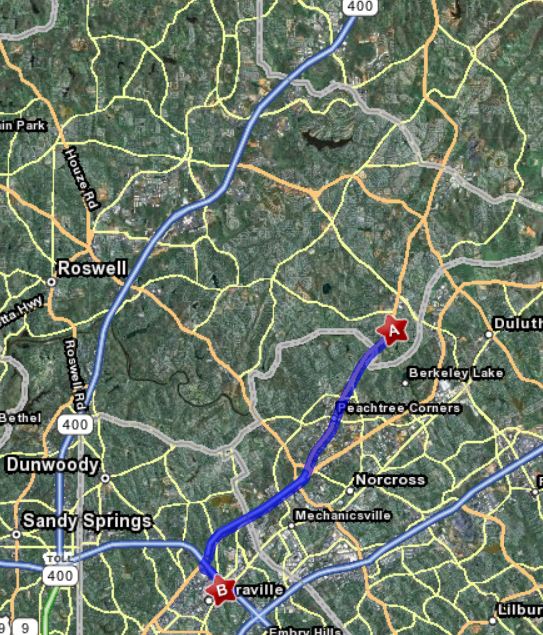
The question then becomes, “Why go through Alpharetta to get to Duluth when there is a much more intelligent and economical solution to extending trains into North Fulton and Gwinnett counties.” Below is a proposed path for a MARTA rail extension that would only require about 10 miles of rail as opposed to the 30 necessary for the plan currently being suggested.

The smarta MARTA

The route shown above requires only 10 miles of new rail lines which is 1/3rd of what would be required for the plan proposed by DOT board member and Chamber of Commerce CEO Brandon Beach. Not only would this route save BILLIONS of dollars but it could be completed in a fraction of the time. That is a tremendous amount of time and money that could be better spent making other much needed infrastructure improvements.

In addition to saving Georgia taxpayers time and money my proposal is also superior to the one being floated by Mr. Beach because it would relieve traffic congestion on both I-85 and GA 400 simultaneously. If you extend MARTA along GA 400 it would only relieve congestion along one existing main artery but by placing a train between two of the most congested highways in Atlanta we could actually double the impact for one third of the cost.

So as you can clearly see, if we decide to expand rail into North Fulton and North Gwinnett then the obvious way to do it would be to extend the Doraville line up the Hwy 141 corridor. And since the solution is so obvious I hope Mayor Bodker will immediately begin pushing land use policies for Johns Creek to help facilitate this important regional initiative. Undoubtedly Mayor Bodker’s constituents will be thrilled with his vision and leadership on this matter.

Brandon Beach pitches trains in Windward on the news

Earlier I covered curious events surrounding a presentation to the Alpharetta City Council by Mr. Brandon Beach. Mr. Beach is a board member of the Georgia Department of Transportation and also serves as the CEO of the Greater North Fulton Chamber of Commerce as well as Director of the North Fulton CID which represents the commercial property owners in the Northpoint Parkway area of Alpharetta.

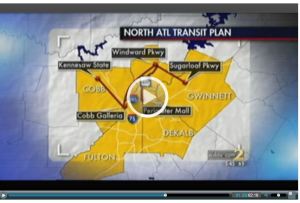
You can read the previous posts here and here for more details. But after Mr. Beach decided not to present his transit plan to our city council you can imagine my surprise when I heard that he had instead chosen to present the plan on WSB’s newscast last night. You can see the clip by clicking on the picture below.

I have seen Mr. Beach give a similar presentation but it didn’t mention taking the train through my neighborhood to Duluth. Needless to say I am not a fan of expanding costly and inefficient trains through my neighborhood and now I understand why he didn’t even bother presenting the plan to our City Council.

In a completely unrelated matter I noticed a few pictures of Mr. Beach in the Alpharetta Revue today. The odd thing was that standing right there with Brandon was Penn Hodge, the developer that owns the land adjacent to the Windward MARTA property. Looked like they were having a great time together at the Ritz Carlton. Small world isn’t it?

But back to the matter at hand, I did like one part of the WSB news story. The clip where Mr. Beach says,”You’ve got Windward… up here… with jobs.” The rest of the clip… not so much.

The incredible disappearing transit machine

Last Friday an agenda item about a transit presentation by Greater North Fulton Chamber of Commerce CEO, Northpoint CID Director and Georgia DOT Board member Brandon Beach magically appeared on the Alpharetta City Council docket for Monday night. I was surprised to see such an item appear out of thin air and wrote about it in this post over the weekend.

Well apparently I wasn’t the only one surprised. Several City Council members told me that they didn’t know anything about it until last Friday either.  Then yesterday, as magically as it appeared, the transit presentation disappeared and never took place. Curious stuff.

Maybe Mr. Beach saw the recent article “The Public Transport Revolution – Why does it never Arrive?” on Newgeography.com and realized that MARTA trains were a waste of time and money. You can read the whole article here but below are a few highlights.

Urban economist, Anthony Downs, writing in “Still Stuck in  Traffic?” reminds us:

“….trying to decrease traffic congestion by raising  residential densities is like trying to improve the position of a painting hung  too high on the living room wall by jacking up the ceiling instead of  moving the painting.”

******************

One of the arguments used against building more roads – and  especially against more motorways – is that as soon as they are built they  become congested again because of “induced demand.” Such “induced demand” is  surely the natural expression of suppressed demand. It seems unlikely  that motorists will mindlessly drive between different destinations for no  other reason than they can.

However, let us accept for a moment that “induced demand” is  real, and suggests that improving the road network is a fruitless exercise. Advocates  of expensive rail networks claim they will reduce congestion on the roads and  improve the lot of private vehicle users as a consequence.

But surely, if the construction of an expensive rail network  does reduce congestion on the roads then induced demand will rapidly restore  the status quo. Maybe the theory is  sound after all. It would explain why no retrofitted rail networks have  anywhere resulted in reduced congestion.

This is the time to invest in an enhanced roading network while  making incremental investments in flexible public transport. Roads can be  shared by buses, trucks, vans, cars, taxis, shuttle-buses, motor-cycles and  cyclists – unless compulsive regulators say they are for buses only. Railway  lines can be used only by trains and if we build them in the wrong place they  soon run empty. The Romans built roads and we still use them.

So maybe the incredible disappearing transit machine shows that local business leaders now realize raising sales taxes to pay for expensive, inefficient trains is a waste of time and money. And maybe the Georgia Department of Transportation will make up for decades of neglecting roads in what has been one of the fastest growing areas in the nation.

And maybe I’ll ride a flying pig to Braves games this Summer.