North Fulton mayors vote to trade MARTA funds for roads

This morning I noticed an article on NorthFulton.com which reports the mayors of North Fulton county have voted to sacrifice extending MARTA into their communities in exchange for more road money:

The North Fulton Municipal Association decided to try to trade $37 million in MARTA engineering funds for the restoration of road projects to be funded by the 2012 transportation-improvement sales tax.

********************

He said Fulton is a net donor to the tax while Cobb County and DeKalb County get a 120 percent return on their investment.

Bodker then criticized the Beltline streetcar project in Atlanta. He said it is an Atlanta project, not a regional one, but it is slated to receive $600 million in funds intended for regional transportation development. He said Atlanta is getting more than its fair share of the revenues and this money is being taken from North Fulton’s hide.

“If Atlanta wants to fund it, they have 15 percent off the top of this thing,” he said.

He said Atlanta would be paying for the project using other people’s money.

*******************

Sandy Springs Mayor Eva Galambos suggested heavy rail would never come to North Fulton, so the $37 million was money wasted.

*******************

The representatives of Alpharetta, Milton and Johns Creek voted in favor; Wood, representing Roswell, voted against it. No representative from Mountain Park was present.

While the shift of $37 million of a $8 Billion dollar tax is a small gesture it does show that the mayors of North Fulton are finally yielding to the political realities in their communities. The strange thing is that just one week earlier the same newspaper published a story from the same reporter which lead readers to believe the mayors unanimously suppported the MARTA funds: 

Bodker said all the mayors support transit, but are concerned there is no regional transit system that all participating governments support. As far as the projects are concerned, the mayors support extending MARTA to Holcomb Bridge Road and eventually Windward Parkway. At the very least, the tax should pay for the necessary engineering, which would cost $37 million. The mayors also unanimously supported completing the proposed Clifton Corridor that would connect MARTA to Emory University, Atlanta’s largest employer, and extending MARTA up I-75 to at least Cumberland Mall.

A complete reversal of the North Fulton Municipal Association’s position in one week? How curious.

Congratulations Mr. Lowery you did it. Now it’s time to put the deck of race cards away.

The referendum on Georgia’s transportation tax increase won’t be on the ballot for more than a year but the Reverend Joseph Lowery is already playing his race card. In writing about the process surrounding the transportation project selection Mr. Lowery writes:

Originally, the committee was composed of all white men, mostly from the suburbs. This glaring imbalance prompted Rep. David Ralston, Speaker of the state House of Representatives, to intervene and request that Atlanta Mayor Kasim Reed be added to the executive committee.

The painful truth is that Ralston, a white Republican from the north Georgia mountains, should not have been involved in such a local issue.

It’s also telling that other committee members failed to recognize that they did not reflect the region’s diverse demographics. It certainly was obvious to many average citizens in Fulton, DeKalb or the City of Atlanta, who collectively represent 40 percent of the vote within the 10-county region.

A similar misstep was brought to light by Mayor Reed last month. During a meeting of the Regional Roundtable, Reed pointed out that a team of consultants selected to manage the $5 million referendum campaign is also exclusively composed of white men.

You can read Mr. Lowery’s column here.

Of course the appearance of the race card during the transportation tax debate isn’t the only time Mr. Lowery has used it lately. Just a few months ago the news broke that the Reverend filed a lawsuit to dissolve cities in the state of Georgia because of he believes the incorporation of the cities were racist acts. You can read about that issue here.

It is sad to see a man with such a proud history stuck in the past. I have spent nearly 5 decades living in Georgia and I remember how things used to be. I am also well aware of the role that Mr. Lowery played during the civil rights movement. I respect what he did and I am grateful that my children will never be exposed to the kind of racism Mr. Lowery fought.

But with all due respect, this is 2011 and the world is not the same as it was in the 1950’s and 60’s. Children born today are 50 years removed from the segregationist policies that Mr. Lowery fought so valiantly. The vast majority of young white people think of segregation as something that might as well have happened in the stone age.

I am 46 years old and the Civil Rights Act was passed before I was born. People born today are farther removed from institutionalized racism than I was from the Great Depression and the depression seemed like ancient history when grown ups talked about it back then.

Time moves on… so do societies. Leaders need to move on as well.

I’m not saying that racism has been wiped off the face of the Earth any more than greed, lust or avarice have. But the world of 2011 is nearly a half a century removed from the racism that the Reverend Joseph Lowery is still fighting. Someone needs to help him understand that he tarnishes his place in history by continuing to fight battles that are already won. Incorporating a city and raising the taxes on every Georgian are policies we can debate but that does not make them racist acts.

Congratulations Reverend Lowery. You did it. Racism may not be extinct but it has been vanquished. It’s time to put the deck of race cards away.

New link on Blogroll: That’s Just Peachy

A few weeks ago I was contacted by a website that consolidates news stories and blog posts that affect the state of Georgia. The website is called Thatsjustpeachy.com and it is similar to the Drudgereport but with a localized perspective.

I spend a lot of time looking for articles that directly affect my family, my community and my state and Thatsjustpeachy has proven to be an excellent tool for finding many of those articles in one place regardless of the source. As a result I am adding Thatsjustpeachy to the GA Jim blogroll for any of my interested readers.

If you’d like to keep up with what is going on in Georgia but don’t have the time to scour hundreds of websites every day I encourage you to check it out.

The federal gravy train is pulling into the station

Drudgereport.com had this headline: “USA has record $61.6 TRILLION in unfunded obligations; $534,000 per household…” The link leads to this report in USA Today. It is a powerful reminder that the United States is in a terrible financial situation and the current levels of government spending are unsustainable.

Read the whole thing but below are a few highlights:

The federal government’s financial condition deteriorated rapidly last year, far beyond the $1.5 trillion in new debt taken on to finance the budget deficit, a USA TODAY analysis shows.

*************

The government added $5.3 trillion in new financial obligations in 2010, largely for retirement programs such as Medicare and Social Security. That brings to a record $61.6 trillion the total of financial promises not paid for.

This gap between spending commitments and revenue last year equals more than one-third of the nation’s gross domestic product.

**************

The $61.6 trillion in unfunded obligations amounts to $534,000 per household. That’s more than five times what Americans have borrowed for everything else — mortgages, car loans and other debt. It reflects the challenge as the number of retirees soars over the next 20 years and seniors try to collect on those spending promises.

*************

The government has promised pension and health benefits worth more than $700,000 per retired civil servant. The pension fund’s key asset: federal IOUs.

The numbers in USA Today are astounding but it isn’t an isolated report. Back in May, Senator John Barrasso of Wyoming released this statement which says:

The numbers don’t lie. Every day, this government borrows another $4.1 billion. We are borrowing at a rate of more than $2 million per minute. Forty cents of every dollar Washington spends is borrowed money, much of it from China. Every American child born today and tomorrow and the next day owes more than $45,000.

The federal government cannot continue to operate this way. It is more clear than ever before that one day soon our nation has to make difficult choices or foreign investors will make those decisions for us as they are doing for Greece.

So what will local governments do when the federal funds dry up? The Wall Street Journal article Threats to Town Halls Stir Voter Backlash shows that budget woes are already forcing some local governments to consider consolidation against the wishes of many constituents. Here in North Fulton we need only look back to the consolidation of Milton County with Fulton County that occurred during the last Great Depression to see what happens when a municipal government is not sufficiently prepared for the fiscal issues it can face.

The current fiscal policies of the United States federal government are unsustainable. The gravy train of federal deficit spending is nearing the end of the line.  Will Georgia and its municipalities be prepared when it does? I hope so.

Money grubbing bureaucrats find they didn’t need to extend GA 400 tolls after all

According to the article Ga. 400/I-85 to be rebuilt, but was new toll needed?  in the AJC:

… for Ga. 400 toll payers who once expected the toll to expire this year, the congestion relief will be bittersweet.  As they now continue paying the toll for another decade to fund the interchange project and others, there is a new kicker. The bid the state accepted Friday for the project is far lower than the state estimated it would be when it made the case that the toll had to be extended.

So low, it raises the question of whether the toll extension was necessary in the first place.

*************

The Atlanta Journal-Constitution noted at the time that the toll authority expected to have $42.5 million  in excess toll reserves at the conclusion of the original toll, meaning that the state did not need to extend the  toll to pay for the  I-85/Ga. 400 interchange. However, Perdue, who chaired the authority as governor, replied that not just those projects, but others  along the corridor needed to be done, too.

If bids on all 11 of those Ga. 400 projects — estimated by SRTA last fall at a total of $67 million — come in at the same low rate under the estimates, the state wouldn’t need the new toll to build any of them.

************

Gena Evans, director of the toll authority, told a legislative panel earlier this year that eliminating the toll could impair the state’s bond rating as well as confidence with investors in public-private toll projects.

Ms. Evans neglected to mention that removing the toll would also impair her ability to collect a six figure salary as the state’s head toll collector if the tolls stopped as promised.

As a wise man once said,”Once you vote to give the government your money they will do with it what they damn well please.” Remember this any time  government asks you for permission to take more of your money.

Hide your kids… Hide your wife… Governor Deal is looking for resources

Georgia Governor Nathan Deal took time from his busy schedule of punishing insolent reporters to appoint a new commisssion to look for innovative ways to stick it to Georgia taxpayers “find the right ways to balance  the educational needs of Georgia’s children with the appropriate resources to  fund them.” You can read all about it here.

A blue ribbon panel of experts and politicians looking for new ways to get money? My wallet feels lighter already.

Why don’t those commissions ever have regular old everyday taxpayers on them? You know… someone that pays taxes but doesn’t benefit from the question at hand. I’d feel a heckuva lot better if the governor had taken Bill Buckley’s advice and just pulled random names out of the phone book instead of hand picking educators, politicians and bureaucrats. Time to sound the Antoine Dobson tax increase alert!

We wouldn’t make students use textbooks from the 1940’s…

The AJC has an article online titled “Population shifts mean big changes for schools”. It gives a good overview of how population shifts cause turmoil and frustration for families that are forced into school redistricting. As I read the article one thought kept going through my mind: Why does the public school system still tell people where their children should go based upon their street address?

Think about it. Geographic school districting has been done since before I was born, but is it really the best way to educate children? Wouldn’t it be better if families could determine which school was best for their children based on a case by case basis? Why does the school system tell a family in a horrible school system that they should attend horrible schools? Why does a family that paid a premium price to buy a home in a great school district have to accept a redistricting based on the decision of a bureaucrat 30 miles away? Why do two families across the street from each other have to send their children to different schools?

North Fulton schools will be redistricted this year and I don’t expect any change in the way that process is handled at this late stage. I also think that the Fulton County School System is trying to do the best they can under the system that is imposed on them by legislation. But it doesn’t have to be this way and I submit to you that it shouldn’t.

The way we educate our children has changed a great deal since the 1940’s. Calculators have replaced slide rules. Computers have replaced encyclopedias. The textbooks now include the Civil Rights movement and the election of our first black president. We have come a long way.

But back in the 1940’s school systems told students which school to attend based on their address and they still cling to that same method. We wouldn’t make students use textbooks from the 1940’s… why do we still use a 1940’s method to determine which school they will attend?

Will Alpharetta really give up our niche?

Yesterday I was reading this post on the Roots in Alpharetta blog. One comment on the “An Alpharetta Lament” post clearly shows how people supporting Alpharetta’s urbanization want our city to look in a few years. It also provides an opportunity to show why so many people are opposed to that vision. The comment was by another local blogger named Michael Hadden. Michael is a vocal supporter of urbanizing Roswell and Alpharetta and he said:

You can take a look at Reston Town Center in Reston, VA.  They have been planning mixed-use since the early 90′s without connection to transit.  The new Metro Silver Line will be opening with a stop at Reston in the next ~3 years

I appreciate Michael’s willingness to explain his vision of Alpharetta’s future because most of the people trying to change Alpharetta just make vague statements like “mixed use is the future” or “there are plenty of examples of successful mixed use” without ever providing one example of what they consider to be a success. So let’s take Michael’s advice and look at Reston, Virginia.

At one time Reston was similar to Alpharetta, Georgia. That time was back in the 1950’s before Dulles International Airport was built just outside of Reston. Since the 1960’s Reston has been between Washington, DC and the nearest international airport making it geographically much more similar to College Park, Georgia than Alpharetta. And unless Forsyth County builds an international airport in the next few years Alpharetta will never really be comparable to Reston.

But despite that major difference we can still look at what the urbanization of Reston has done to see what urbanization would bring to Alpharetta. First urbanization will bring more traffic. I worked in Reston, Virginia back in the 1990’s and anyone that says high density developments solved their traffic problem has never been there. Stacking people in buildings 5, 10 or 15 stories high does not relieve congestion. It makes it worse. Urban planners know that. They just don’t care because they want to force people out of their cars anyway.

Michael points out that mass transit will come to Reston and that may well be true. Once urban planners have succeeded in making traffic unbearable enough people are willing to spend billions on inefficient rail projects in the hope it will bring relief.

There are three main reasons a transit trains will come to Reston:

1) High density urbanization created a traffic nightmare

2) The traffic nightmare stands between politicians and an airport

3) The politicians are inconvenienced enough that they were willing to spend billions of taxpayer dollars to get the common people off of the roads between themselves and the airport

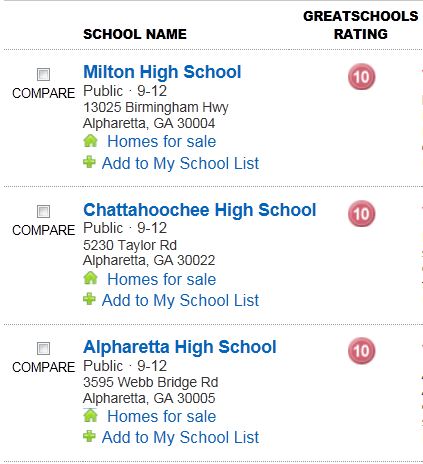
The second consequence of urbanizing Reston is a mediocre public school system. North Fulton County and South Forsyth County now have some of the best schools in the nation. So let’s see what the future holds if the city of Alpharetta continues down the path being laid by our current City Council. Below are the comparisons of schools in Alpharetta and Reston according to Greatschools.org (You can click on the image to enlarge)

Here are the elementary school ratings:

Alpharetta elementary schools

Reston elementary schools

And here are the high school ratings:

Alpharetta High Schools

Reston high school

There really is no comparison. High density development results in lower test scores. Alpharetta’s low density neighborhoods produce public schools which are among the best in the nation. Reston’s high density developments produce mediocre public schools.

In marketing terms Alpharetta has a “niche” now that brings people to our city when they move to the metro area from all over the world. The Atlanta Regional Commission is trying to change that with the help of our community develoment department and city council. If they succeed our community will be just be another congested concrete jungle with bad schools and nothing special to offer that can’t be found in Buckhead, Sandy Springs or Marietta.

The choice is clear. Alpharetta can continue to draw families with our great public schools and high quality of life much like East Cobb County has for decades. Or we can urbanize and compete with Sandy Springs, Buckhead and Marietta on price alone. The Atlanta Regional Commission and the City of Alpharetta have made their choice obvious. What do you think?

The decentralization of power is a good thing

Jim Galloway has another insightful column up at the AJC’s Political Insider blog. He uses the recent advance of the Sunday Alcohol Sales bill to point out how the Tea Party movement has caused a decentralization of political power in Georgia.

“Republicans often talk of the chill that last November’s tea party-driven vote sent up President Barack Obama’s spine. Only rarely do they acknowledge that those same ballots signaled a shift to a more libertarian brand of conservatism within the GOP.”

“It’s a bill about local control,” Bulloch said. And we’re all about limited government these days, because the pitchforks – once held by followers of Ralph Reed and Pat Robertson — are now in the hands of tea partyers.”

I for one would welcome this decentralization of power. One of the consequences of concentrating money and power in a central location is that it makes it much easier for lobbyists to influence where that money ends up being spent. The farther the decision making process gets from the taxpayer the less chance there is that the money will actually be spent to benefit that taxpayer. The supporters of turning North Fulton into Milton County are using this same justification for local control.

With that in mind my favorite quote from Galloway’s column is by the head of the Georgia Christian Coalition, Jerry Luquire, as he explained why he didn’t bother to attend the hearings on Sunday alcohol sales,

“I don’t show up at the Capitol much anymore because that’s not where the power is anymore. The power is among the people”.

I don’t care if you support the Tea Party or not, I would hope we can agree that the power being back with the people is a good thing.

If you are interested in Georgia politics then the Political Insider is a must read and you can find the whole article here.

Tax and Spend Republicans #2

I was born in October so I recently received a thoughtful note from the state of Georgia requiring me to send them $200. What a great way to celebrate the joyous occasion of my birth. If you own a car here in Georgia you too have probably received one of these car tag bills. Isn’t government thoughtful? And if Republicans get their way the state’s gift to you next year could be even larger. Oh Boy!

The tax increase I am talking about is state constitutional amendment #2 which is on the ballot this year. The amendment says,”Shall the Constitution of Georgia be amended so as to impose an annual $10.00 trauma charge on certain passenger motor vehicles in this state for the purpose of funding trauma care?”

But that can’t be right because Georgia Republican politicans told us that the trauma care in question would be paid for by the “Super Speeder” law they passed last year. Remember when Republicans raised speeding ticket fees by $200? Didn’t our elected officials tell us that exorbitant fines for speeding would raise $23 million dollars a year to pay for the state’s needed trauma centers? Yes they did. They were wrong.

 The super speeder law has been an abject failure when it comes to raising money. The state has only received about $2 million of the $23 million they projected. Much to the surprise of politicians it turns out that when you charge people hundreds of dollars for something they stop doing it. And since the first Republican tax has failed to raise enough money the only solution is for us to send them even more money. Well at least they will repeal the super speeder law since it didn’t raise enough money,right? Fat chance. And how much of the $2 million they have raised has gone toward trauma care? I’m guessing the over/under is 0.

Now I realize that the Republicans of Georgia are generally more conservative than the Democrats. But George Bush was more conservative than Al Gore and you see where that got us.

Somewhere along the way the majority of Republicans of Georgia have lost sight of the fact that it is impossible for governments to do everything for everybody. Eventually you run out of other people’s money, as Margaret Thatcher once said. If you don’t believe her just look at the financial situation in Cuba, Venezuela, California or Illinois.

I am not against more trauma centers in Georgia but I do believe another tax on every car owner in Georgia is the wrong way to solve the problem and I am opposed to the state of Georgia reaching deeper into the pockets of my family every time it tries to address a problem. I am also tired of politicians calling themselves conservative as they take more and more money away from their constituents.

Georgia Republicans often have good intentions but you know what they say about the road to hell. Of course, if we could pave roads with good intentions the Republicans might not be advocating a new transportation tax.