Which way forward Georgia… Texas or California?

The state of Georgia is in a good place. Yes we have tremendous challenges. Our billion dollar deficits, failed banks, double digit unemployment and rampant home foreclosures are huge problems but nearly every state in the nation is facing such difficulties.

The difference between most states and Georgia is that we are in a perfect position to capitalize on the economic challenges facing us. Georgia can choose to develop an economic climate that will not only survive a difficult environment but actually thrive in it. 

Texas is already doing it. For more than a year now I have watched as the state of Texas has become a magnet for jobs and growth in the worst economy of my lifetime. In fact, as stated by Rich Lowry on National Review Online:

According to the Bureau of Labor Statistics, 214,000 net new jobs were created in the United States from August 2009 to August 2010. Texas created 119,000 jobs during the same period. If every state in the country had performed as well, we’d have created about 1.5 million jobs nationally during the past year, and maybe “stimulus” wouldn’t be such a dirty word.

What does Austin know that Washington doesn’t? At its simplest: Don’t overtax and -spend, keep regulations to a minimum, avoid letting unions and trial lawyers run riot, and display an enormous neon sign saying, “Open for Business.”

Of course since our state has the opportunity to make good choices we also face the chance of making a bad choice. Fortunately California provides a glimpse into the future of what Georgia would become if we choose our economic model poorly. To illustrate I suggest you read Mark Hemigway’s piece titled “Texas booms while California busts” in the Washington Examiner. The first installment of the five part series outlines the two contrasting business models:

Broadly speaking, the two states have many similarities. They have diverse economies, large urban areas, a border with Mexico and similar demographic make-up, with Hispanics a third of the population. Yet one state is failing and one state is succeeding.

California is facing budget shortfalls in excess of $20 billion each year for the next five years, and acquires $25 million in new debt each day. “We’ve been living in fantasy land. It is much worse than I thought. I’m shocked,” then California Gov.-elect Jerry Brown, D, told the Los Angeles Times.

By contrast, when Gov. Rick Perry, R-Texas, campaigned successfully for a third term this year, he ran ads touting the fact that his state has billions in surplus. In fact, Texas was one of only six states that did not run a budget deficit in 2009.

******

Perhaps the most dramatic illustration of Texas’ superiority is that Americans have been stating their preference for the Lone Star State with their feet.

Between 2000 and 2009, California had a domestic outflow of 1.5 million people, while Texas had 850,000 move in from other states. From 2008 to 2009, Texas’ population inflow was double that of any other state.

So how have two similar states ended up in such radically different situations? The answer is smaller government.

The economic climates of Texas and California could not be more different and the results could not be more evident. Texas is a model for success and California is a model for failure.

The people of Georgia hold our destiny in the palm of our hands. Let’s just hope that the state’s extension of the GA 400 toll and Transportation Tax Increase aren’t indicative of the path our government intends to follow.

You can read all of  Mr. Hemingway’s article and follow the future installments here.
The decentralization of power is a good thing

Jim Galloway has another insightful column up at the AJC’s Political Insider blog. He uses the recent advance of the Sunday Alcohol Sales bill to point out how the Tea Party movement has caused a decentralization of political power in Georgia.

“Republicans often talk of the chill that last November’s tea party-driven vote sent up President Barack Obama’s spine. Only rarely do they acknowledge that those same ballots signaled a shift to a more libertarian brand of conservatism within the GOP.”

“It’s a bill about local control,” Bulloch said. And we’re all about limited government these days, because the pitchforks – once held by followers of Ralph Reed and Pat Robertson — are now in the hands of tea partyers.”

I for one would welcome this decentralization of power. One of the consequences of concentrating money and power in a central location is that it makes it much easier for lobbyists to influence where that money ends up being spent. The farther the decision making process gets from the taxpayer the less chance there is that the money will actually be spent to benefit that taxpayer. The supporters of turning North Fulton into Milton County are using this same justification for local control.

With that in mind my favorite quote from Galloway’s column is by the head of the Georgia Christian Coalition, Jerry Luquire, as he explained why he didn’t bother to attend the hearings on Sunday alcohol sales,

“I don’t show up at the Capitol much anymore because that’s not where the power is anymore. The power is among the people”.

I don’t care if you support the Tea Party or not, I would hope we can agree that the power being back with the people is a good thing.

If you are interested in Georgia politics then the Political Insider is a must read and you can find the whole article here.

Three cheers for Rupert Parchment & Decor Moving Services of Atlanta

An Atlanta business is offering a special relocation deal for Illinois residents hoping to avoid the recent income tax increases in that state:

Décor is offering the “I’m Outta Here” special of 10-50% off of their already discounted rates for those who wish to exercise their right to relocate. The special is described as relief from higher taxes with financial savings for those businesses or residents who relocate to Atlanta, GA. The “I’m Outta Here” special starts immediately and is described as a way to welcome new jobs to Georgia and help people burdened by high taxes.

“As a small business owner, I’m struggling to stay above water. Where would I be without my employees? I can’t reduce salaries any more. I can’t lay more people off. It’s heart-wrenching. When you already are hungry, adding more taxes is like drawing blood from a rock. We just don’t have it to give,” said Rupert Parchment, Owner of Décor Moving Services, Inc.

I applaud Mr. Parchment for his using his conservative beliefs to create a brilliant marketing campaign. Hopefully he will attracts enough business to keep his employees busy in an industry which has taken some major hits in recent years. Good Luck to Mr. Parchment and Decor Moving Services as they have the inside track to being named GA Jim’s business of the year for 2011!

Read the whole thing here.

Georgia’s GDP: “Obviously all is not well down there”

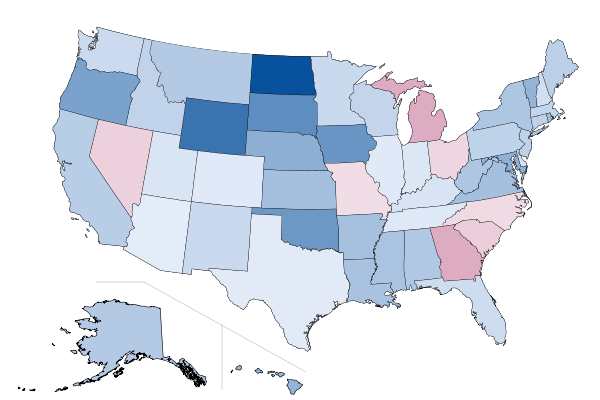
According to Newgeography.com the real per capita Gross Domestic Product of Georgia has actually declined from the years 2000-2009. Below is the map showing that the states with the largest decline in per capita GDP are Michigan and Georgia.

To quote the author, Aaron Renn, “Some of the fast growing Sun Belt states added people at a faster rate than they grew economic output. Georgia in particular is worth noting, because even metro Atlanta has been showing declining real per capita GDP. In fact, Georgia actually declined by more than Michigan did on this metric, so obviously all is not well down there.”

I was really shocked to see this but it does remind me of a map I saw a while back that showed the migration of people in and out of Georgia along with their incomes. The first thing I noted about that map was that Georgia had a positive net migration but the people moving in had much lower incomes than the people moving out.

Looking on the bright side, the good news is that more people are moving to Georgia than leaving. The bad news is that the people moving in have lower incomes.

Read the whole thing here.