The $100 Emission Inspection Challenge

Every year around their birthday car owners in metro Atlanta are required to have their automobile emissions inspected before they can renew their car tag. This is required by the federal government purportedly to reduce pollution in Atlanta and the last time I checked the annual cost to taxpayers was between $80 million and $100 million.

Five years ago on my birthday I was so annoyed at having to spend $25 to have an emission inspected that I decided to find out if there was any evidence the millions of dollars we pay for the inspections make any difference.

I started with Google but there was no evidence on the internet. Nothing at all on the world wide web to scientifically prove metro Georgia’s emissions inspection program reduces pollution by even .000000000000000000001%. But the federal government couldn’t possibly make people waste so much money for no reason, could it?

Next I called the office of State Senator Dan Moody who represented me at the time. His staff was very nice and helpful but they knew of no such evidence themselves and referred me to a person in the Georgia Department of Natural Resources.

The lady at the Department of Natural Resources was also very friendly and helpful but did not have the evidence I needed either. However she did refer me to a report issued by researchers at Georgia Tech which was supposed to support the tens of millions of dollars spent on inspections.

Unfortunately the report only showed that pollution levels around Atlanta were lower than they used to be. There was no evidence at all that emissions inspections had any impact nor any quantifiable result for what hundreds of millions of dollars had accomplished. You can read an article about the report here: http://gtresearchnews.gatech.edu/newsrelease/vehicle_emissions.htm

But despite the lack of supporting evidence I didn’t want to believe the federal government was forcing Georgians to spend up to $100 million a year for no reason so I wrote to Michael O. Rodgers, Ph.D. the Principal Research Scientist and Adjunct Professor School of Civil and Environmental Engineering Georgia Institute of Technology who directed the research:

Mr. Rodgers,

I am currently doing research on the effectiveness of Georgia’s emission inspection program and came across an article which sites your research. Here is the link to the article: http://gtresearchnews.gatech.edu/newsrelease/vehicle_emissions.htm

The article explains how your research found lower emissions in Georgia but it doesn’t really explain how a cause and effect relationship was established between the emission levels and the inspection program. Is the underlying research publicly available so I can better understand how you determined the specific contribution of the emissions inspection program.

Thank you in advance for any help you can give me in proving the effectiveness of Georgia’s emission inspection process.

Jimmy Gilvin

Dr. Rodgers responded to my request and for several weeks promised to have an assistant send the evidence I requested. We even spoke on the phone, He seemed very nice but for several weeks Dr. Rodgers would assure me the information was forthcoming yet it never showed up.

I continued to follow up on the missing report until Dr. Rodgers stopped returning my calls and I realized what I now believe to be the truth: There is absolutely no scientific evidence to show hundreds of millions of dollars in Georgia emission inspection fees have reduced pollution one bit.

So here is the $100 Emission Inspection Challenge: The first person who can demonstrate there is scientifically valid evidence that the tens of millions of dollars spent on emissions inspections have reduced pollution in the metro Atlanta area by more than .000000000000000000001% will get $100.

When a person starts with the premise that annoying federal mandates are ridiculous and based on political agendas rather than facts you will rarely be wrong. Prove me wrong in this case and I will gladly fork over the cash just to know that the federal government hasn’t really wasted more than a billion dollars of our money on a charade.
“Legislators critical of proposed rail line”

Interesting article in the Marietta Daily Journal about the fault lines that are appearing in the political support for the transportation tax increase. You can read the whole thing here but below are some of the juiciest tidbits:

Cobb lawmakers on Monday criticized the proposed light rail line from Midtown  Atlanta to Cumberland Mall which constitutes the majority of Cobb’s take in next  year’s vote on a regional TSPLOST.

******************

The $856.5 million number is the conservative estimate. The maximum cost is  targeted at $1.234 billion, according to the county.

******************

“We’ve got huge infrastructure needs in far west Cobb  County, and to ask those people that I represent to support a mile’s worth of  rail that’s finished in 2026 when they have to drive to work every morning would  be something that doesn’t fix the here and now, and I doubt they’d be very happy  with me for supporting something like that.”

****************

Cooper said the rail line would clearly benefit one area of the county, the  Cumberland Community Improvement District.

****************

Setzler reiterated what he told the Journal on Friday, which is the rail line  would only benefit five percent of the county while at the same time costing  each household in Cobb $4,000.

*****************

“We know that rail offers some things that you can’t get from just building  roads,” Rogers said. “But we also know that rail doesn’t do a great job in  lessening traffic, and at a time when we need traffic to be lessened  significantly..”

Although this article is about legislators in Cobb County it is especially relevant to the people of North Fulton county for three key reasons:

1. The political climate in North Fulton is almost identical to that of Cobb County.

2. Elected officials in Cobb County acknowledge transit is really just a subsidy for commercial property owners in the local CID.

3. Traffic is the primary concern for voters in both areas yet transit projects will have no positive impact on traffic during the supposed 10 year duration of the tax.

As North Fulton opponents of the tax increase become more vocal I expect we will see our elected officials do the same.

Partisan bickering over Georgia’s transportation tax illustrates why it won’t solve anything

Jim Galloway points out in his Political Insider column for the AJC that the campaign to squeeze more money from Georgia’s taxpayers has hit another speedbump:

At the state Capitol, next year’s statewide round of regional sales tax votes is again in trouble.

At issue is legislation backed by Gov. Nathan Deal to shift the day of the vote from the July primary, when the electorate is likely to be overwhelmingly Republican, to the November general election.

Tea-party Republicans against the sales tax are opposed to changing the date, accusing supporters of trolling for voters churned out by President Barack Obama’s re-election bid. In a private session with Republican lawmakers from metro Atlanta, Deal this week quietly argued that presenting a tax initiative before the largest audience possible is in keeping with GOP principles, according to people who were in the room.

In addition to Deal’s backing, another good sign for supporters is that the legislation to change the date of the vote is sponsored by House Speaker pro tem Jan Jones of Alpharetta — the most powerful metro Atlanta lawmaker in the Legislature. So the Republican side of the transit sales tax vote may be close, but it’s likely to hold together.

********************

Democrats in Fulton and DeKalb counties have supported next year’s transit sales tax vote — but only reluctantly, given that their voters have long been paying an extra penny sales tax to fund MARTA.

With tea party Republicans opposing the issue from the right, black lawmakers will be needed to make up the difference, if the date to shift the transit vote is to succeed.

State Sen. Emanuel Jones, D-Decatur, chairman of the Legislative Black Caucus, said his members are angry enough over the Senate map to lock down on the transit issue. “I think our caucus would be inclined not to cooperate,” Jones said.

It is sad to see such an important issue bogged down in partisan politics but it is completely predictable. Georgia’s transportation problem isn’t caused by a lack of money it is caused by an incompetent political class. As I wrote in this post last year:

The political class say they could fix the problem if they only had more money. What the political class doesn’t understand is that the voters don’t blame infrastructure needs on a lack of money, the voters place the blame on the political class. Taxes in Georgia are the 16th highest in all of the United States while transportation spending is 49th out 50. See the problem?

But Georgia’s political class won’t accept the fact that they have been the problem. Instead, the politicians and lobbyists  sat down together and once again hammered out an agreement acceptable to the politicans and lobbyists.  And once again their solution is to raise taxes… billions and billions of dollars in taxes. That solution must have sounded awfully good in their echo chamber because a few months ago the political class unveiled this genius idea to great fanfair and they patted themselves on the back so hard that Atlanta’s chiropractors must have made a fortune.

But the people that will pay for this enormous tax increase are not impressed, they are hurting. They face 10% unemployment while the other 90% are still unsure of the future. More than 12,000 Georgia homes were foreclosed in July. IRA accounts and home prices are going down while grocery and gasoline prices are going up. To make matters worse their federal income taxes are going up in a few weeks and they will have even less money to spend. Georgia voters are hurting and they find it offensive that political insiders have decided taxpayers need to pay billions of dollars more to fund transportation improvements. While transportation improvements might bring jobs to Georgia in a decade or so, the state’s taxpayers would have to cough up billions of dollars that could have gone to pay their mortgage or put food on the table in the meantime.

The tax increase being pushed to solve Georgia’s very real transportation problem won’t solve anything because lack of money isn’t the problem. Lack of effective leadership is.

Georgia’s statewide transportation charade

Yesterday the AJC posted an editorial by Neal Boortz titled Our transportation record shows lack of leadership. He makes some excellent points so I hope you read the whole thing. Below are a few choice selections:

I’ve been reading the AJC’s coverage of the machinations surrounding the  multibillion dollar transportation infrastructure tax referendum scheduled  to descend upon us next summer. And so, a question: Considering the  transportation track record of the brilliant traffic planners and engineers  in the Atlanta region, do you really have the confidence to put a few  billion dollars in their hands for more projects and “improvements”?

Let’s just look at the record. First we’ll deal with that traffic monstrosity  known as the Downtown Connector. If you weren’t born here you probably don’t  know that what is now the Downtown Connector was supposed to be the route of  I-85. I-75 was supposed to come roaring in from the North along what is now  Northside Drive to cross I-85 around the airport. Someone decided we could  save some money by simply combining the two through the city. That certainly  worked out well, didn’t it?

******************

Pity also, if you will, the poor saps traveling down Ga. 400 toward downtown.  Your typical suburban families eager for an evening of fun at Underground  Atlanta. There our transportation wizards funnel four lanes of traffic down  to one for the transition to I-85 … and Lord help you if you cross the  gore, that white line separating the highways from the on- and off-ramps.  See you in court.

******************

The new tax is also supposed to fund some rail projects as well, right? Will  these projects be designed by the same geniuses who didn’t put a MARTA  station at what was then Atlanta-Fulton County Station — a station that  would now serve Turner Field — because Atlanta was afraid it would lose  parking revenue at the stadium? Can the people who made this decision be  banned from getting anywhere near even 1 cent of this new tax revenue?

Boortz is right. How can any rational person believe that the dysfunctional politicians, consultants and bureaucrats that got us into this mess will ever solve anything?

If you doubt me just consider that after months of political haggling the geniuses in charge have managed to compile a list which would spend more than 6 Billion Dollars without making any noticeable impact on Atlanta’s traffic problem. Look at the list yourself.

Notice anything strange? The state is trying to sell people on higher taxes for a plan that doesn’t even begin to cover the cost of the projects they are including!

The state list says that they will spend $172,000,000 to improve the exchange at GA 400 and I-285. But the cost of the project is projected to cost $450,000,000. The list also calls for $37,000,000 to bring MARTA to Roswell… but it projects the total cost to be more than $900,000,000. Transit advocates have been all excited about the inclusion of One Billion Dollars to expand MARTA into the I-20 and Clifton Road areas. But apparently it doesn’t bother them that the state expects it to actually cost nearly Two Billion Dollars. So even if those projects could relieve traffic the state would still need another Two Billion Dollars to get them all done.

But we are falling into a trap if we worry too much about the list anyway. It is an illusion. The project list will carry no more weight than a flyer handed out by a used car salesman.

The list to be voted on next year will not be a binding contract… on the state. When the state takes money from one promised project to cover the gap they have in another, taxpayers will have no recourse. Remember what they did with the GA 400 tolls?

So realize that the entire transportation tax charade is just one big, happy waste of time intended to get the “buy-in” of Georgia taxpayers and facilitate a new pipeline of money for the people responsible for our transportation mess in the first place. The same people that created the downtown connector and routed MARTA away from Atlanta Fulton County stadium will decide where Billions of dollars in extra tax money go and there won’t be a darn thing we will be able to do about it. Yay!

Another nail in the coffin of Georgia’s proposed transportation tax increase…

The Dekalb county commission just raised property taxes 26% to cover the county’s budget deficit. As a result Dekalb County residents will suffer a 50 million dollar tax increase even as their property values have declined. In exchange for that $50 million Dekalb residents won’t receive any additional services or benefits and are already being warned that the higher taxes still may not be enough.

As reported in the AJC:

Residents also will need more money. The new incorporated tax rate is 21.21 mills. The tax hike adds $93 a year to the tax bill on the average home, which dropped in value since last year.

But tax bills increase far more where home values have remained the same, with a $420 increase, for instance, on a home that remained at $300,000.

Those kinds of hikes will hit northern and central DeKalb particularly hard, because many home values there barely dropped. Commissioner Elaine Boyer, who represents northern DeKalb, called the tax hike a “slap in the face” for her constituents.

Boyer, who with May and Commissioner Sharon Barnes Sutton voted against the budget, said she also worried that without long-term forecasting, no one could say another tax hike won’t be needed next year.

Dekalb taxpayers are the only Georgia residents other than those in Fulton County that already have to pay a 1% sales tax to support MARTA. The new $50 million tax increase makes it less likely those same residents will choose to pay another 1% for transportation every time they spend their hard earned money.

The coffin nails are starting to add up at what be an alarming rate for those people determined to raise taxes in Georgia and proponents of the transportation tax increase know it. That is why they are moving the vote to a time when more tax and spend Democrats will likely be voting.

But even tax and spend Democrats have a limit to what they can tolerate. One must wonder if even Dekalb County Democrats may reach that limit before the transportation tax increase comes up for a vote.

Congratulations Mr. Lowery you did it. Now it’s time to put the deck of race cards away.

The referendum on Georgia’s transportation tax increase won’t be on the ballot for more than a year but the Reverend Joseph Lowery is already playing his race card. In writing about the process surrounding the transportation project selection Mr. Lowery writes:

Originally, the committee was composed of all white men, mostly from the suburbs. This glaring imbalance prompted Rep. David Ralston, Speaker of the state House of Representatives, to intervene and request that Atlanta Mayor Kasim Reed be added to the executive committee.

The painful truth is that Ralston, a white Republican from the north Georgia mountains, should not have been involved in such a local issue.

It’s also telling that other committee members failed to recognize that they did not reflect the region’s diverse demographics. It certainly was obvious to many average citizens in Fulton, DeKalb or the City of Atlanta, who collectively represent 40 percent of the vote within the 10-county region.

A similar misstep was brought to light by Mayor Reed last month. During a meeting of the Regional Roundtable, Reed pointed out that a team of consultants selected to manage the $5 million referendum campaign is also exclusively composed of white men.

You can read Mr. Lowery’s column here.

Of course the appearance of the race card during the transportation tax debate isn’t the only time Mr. Lowery has used it lately. Just a few months ago the news broke that the Reverend filed a lawsuit to dissolve cities in the state of Georgia because of he believes the incorporation of the cities were racist acts. You can read about that issue here.

It is sad to see a man with such a proud history stuck in the past. I have spent nearly 5 decades living in Georgia and I remember how things used to be. I am also well aware of the role that Mr. Lowery played during the civil rights movement. I respect what he did and I am grateful that my children will never be exposed to the kind of racism Mr. Lowery fought.

But with all due respect, this is 2011 and the world is not the same as it was in the 1950’s and 60’s. Children born today are 50 years removed from the segregationist policies that Mr. Lowery fought so valiantly. The vast majority of young white people think of segregation as something that might as well have happened in the stone age.

I am 46 years old and the Civil Rights Act was passed before I was born. People born today are farther removed from institutionalized racism than I was from the Great Depression and the depression seemed like ancient history when grown ups talked about it back then.

Time moves on… so do societies. Leaders need to move on as well.

I’m not saying that racism has been wiped off the face of the Earth any more than greed, lust or avarice have. But the world of 2011 is nearly a half a century removed from the racism that the Reverend Joseph Lowery is still fighting. Someone needs to help him understand that he tarnishes his place in history by continuing to fight battles that are already won. Incorporating a city and raising the taxes on every Georgian are policies we can debate but that does not make them racist acts.

Congratulations Reverend Lowery. You did it. Racism may not be extinct but it has been vanquished. It’s time to put the deck of race cards away.

AJC: “Cherokee could be tough sell on transit vote”

The latest edition in the AJC’s ongoing series about the upcoming vote to increase Georgia’s sales tax explores the reaction in Cherokee County. I will post some highlights below but you should read the whole thing here.

But it’s an open question whether using part of the transportation tax for mass transit somewhere else in the region might be a lightning rod for residents in the distant suburbs, including Cherokee.

*******************

A public-private project to add toll lanes to I-75/I-575 in Cobb and Cherokee counties could wind up on the final list of projects the tax would fund.

*******************

“People in our group will actively oppose it,” he said. “We think the government needs to back off and let this economy recover a little bit first.”

The snippets above illustrate three of the biggest challenges facing the state of Georgia and the various Chambers of Commerce which are pushing the tax increase.

First, the majority of urban dwellers won’t vote for higher taxes to pay for roads while the majority of suburban dwellers won’t vote for higher taxes to pay for mass transit they won’t use. Watching tax increase advocates attempt to convince both groups they will get what they want should be entertaining.

Second, will taxpayers vote for higher taxes to build toll roads that will take even more money out of their pockets? I can’t speak for Cherokee County residents but based on our experience with the false promises about GA 400 tolls in Fulton County I personally wouldn’t make that mistake again.

Third, the U.S. economy is in the tank so is it really the time to take more money from people suffering from 10% unemployment, sinking property values and rampant inflation for food and gas? I think politicians are underestimating how sick taxpayers are of being asked to did deeper and deeper for more taxes regardless of how good the cause.

There are a lot of politicians, consultants, lobbyists and developers dedicated to passing this tax increase and don’t doubt for a minute that they will do whatever it takes to get it passed. They will also promise gullible voters anything to get their vote so don’t forget my maxim when it comes to tax increases,”Once you vote to give the government your money they will do with it what they damn well please.”

Flying coach is for the little people

Kyle Wingfield of the AJC is fired up about Georgia politicians accepting free perks from Delta and he’s right to be disappointed. Can you imagine if Delta were the defendant in a trial and gave the judge free frequent flyer miles during pre-trial hearings? That would be absurd. So what is the difference? From the article:

The upgrades are properly understood as gifts — lobbying gifts — from a company seeking an extension of the partial exemption on sales tax for jet fuel it’s enjoyed since 2005. Delta got just that when HB 322 was passed this spring, saving the company tens of millions of dollars.

No wonder it passed: Besides Ralston, Delta contributed to Speaker Pro Tem Jan Jones, House Majority Leader Larry O’Neal and House Transportation Chairman Jay Roberts, who sponsored HB 322. On the Senate side, it wasn’t only Cagle and Williams but Majority Leader Chip Rogers and Ronnie Chance, a floor leader for the Deal administration.

*************************

For some reason, this story got my goat more than the typical campaign-money revelation. Maybe it’s the obviously false pretext that these gifts were election-related.

More likely, it’s the reinforcement that our elected officials believe they deserve a cushier lifestyle than their constituents. Not because they can afford it, but just because they’ve been elected.

As Bob Irvin, former House minority leader and past chairman of Common Cause Georgia, told me, “This just ought to be stopped. It feeds the entitlement mentality of people in government. And while we’re fixing the entitlement problems for the country as a whole, we ought to be fixing it for government officials and staff, too.”

Every single day there are thousands of people in Georgia volunteering their time on behalf of their community. These people volunteer in soup kitchens, teach Sunday school classes, coach baseball or softball and donate time to the local PTA just to name a few. And not a single one of them expects to get free gifts worth thousands of dollars for their service to society. Yet for some reason many of our current political “public servants” seem to think their contribution is so singularly important that they should be entitled to special privileges.

Former Speaker of the House Nancy Pelosi dictated that the “little people” of the United States had to use low flow toilets and cfl light bulbs while she flew around on gigantic military aicraft stocked with enough booze to supply an entire Russian village for a year. Before Dominique Strauss-Kahn was arrested for raping a hotel maid, the head of the International Monetary Fund was staying in $3,000 a night hotel rooms while he redistributed wealth from the United States to people all over the world.

Membership in the ruling class does have its privileges.

Over the Weekend

Governor Deal strikes back at reporters telling the truth. Anyone that is surprised by Governor Deal using political money to benefit his family clearly wasn’t paying attention during the election but what bothers me even more than Governor Deal’s actions are his reactions in this case. Facts are facts and politicians that don’t want facts to be exposed remind me of a something I read once. I don’t remember the source or the exact quote but it was basically,”If you don’t want people to know what you  are doing… Stop Doing It!”

Carlos Santana, musical genius and immigration moron I love Carlos Santana’s music and I am generally accepting of marketing spectacles like Major League Baseball’s “Civil Rights Game” at Turner Field Sunday. But giving a platform to ignorant hypocrites like Carlos Santana is not advancing the cause of civil rights. How dare he come to our state and criticize us for our immigration laws when Mexico’s immigration laws are draconian by comparison. I am prohibited by law from owning land in Mexico and “Foreigners who are deported from Mexico and attempt to re-enter the country without authorization can be imprisoned for up to 10 years.” Would Mr. Santana prefer we just adopt the same standards of his homeland?

And in the really important news: Atlanta Braves won 2 out of 3 from the Philthies!

Atlanta Regional Commission disproportionately represents seniors

Today’s Atlanta Journal has an article that reminds me of something most people don’t realize: the Atlanta Regional Commission disproportionately represents seniors in the metro Atlanta community.

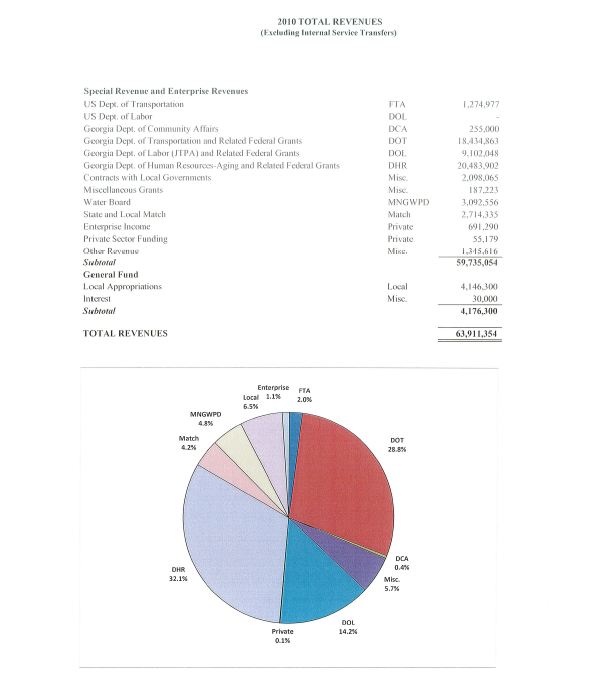
The article is Metro Atlanta getting older quickly and it is about the aging of the suburban population in Atlanta. It is a good article and I recommend you read the whole thing. As you do, also keep in mind that control of local issues like zoning and transportation are being systematically regionalized to an organization primarily responsible for providing services to the elderly, the Atlanta Regional Commission. Below is a graph of the ARC’s revenue sources and you can see that about one third of their money, more than 20 million dollars, comes from federal grants to serve Atlanta’s aging population.

ARC Revenue

The reason I point this out is that the AJC article makes it seem as though Atlanta is overwhelmed by an elderly population that it estimates to be 472,000 when in fact that is less than 10% of the metro area’s total population. Our aging population is certainly an important part of Atlanta’s community and future but it is still a relatively small percentage of our overall population.

And yet ARC, the organization which is increasingly responsible for the economic future of our entire state, is primarily an organization responsible for services catering to less than 1/10th of our population. Regardless of how you feel about government involvement in these kind of social programs it seems obvious that such a distortion is not in the best interest of our region.